The First Second Is the Whole Negotiation
The first second doesn't grab attention — it interrupts a departure already in progress. Here's how to win that moment.
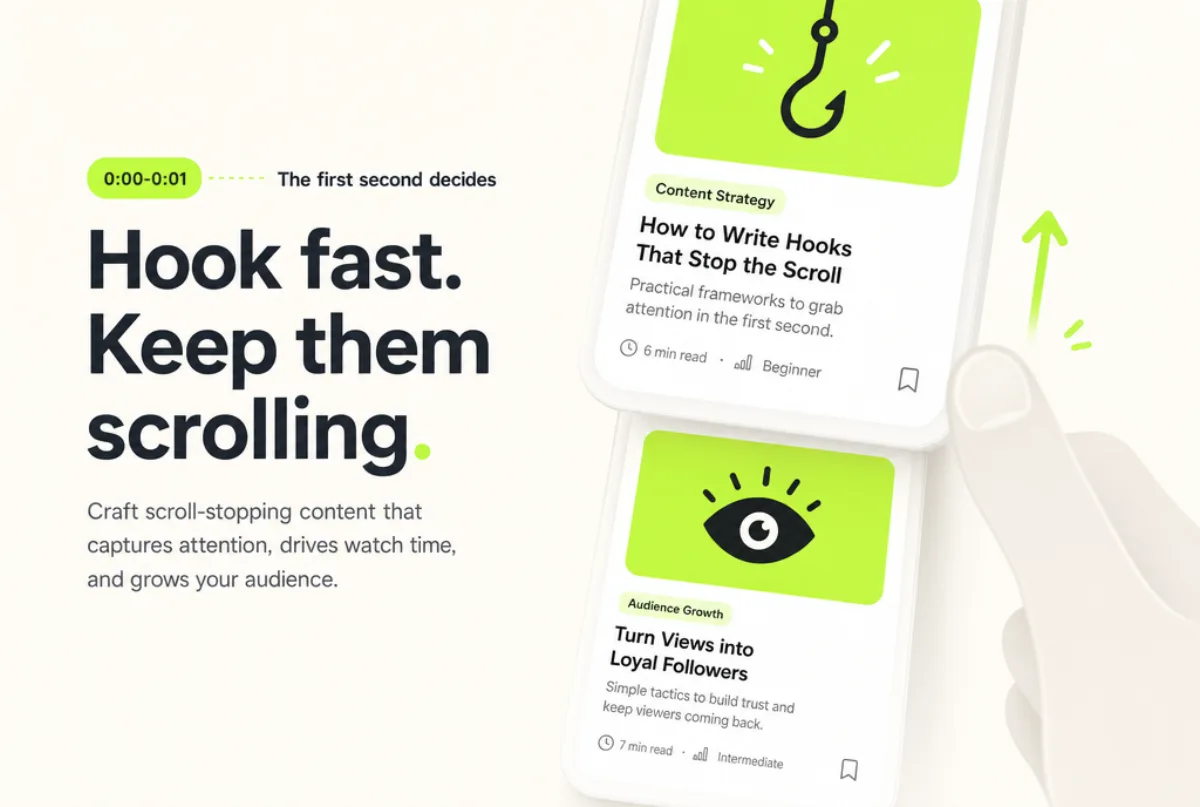
The advice "you have one second to grab attention" sounds right and quietly misframes the problem.
A scrolling viewer isn't sitting still waiting to be grabbed — their thumb is already mid-flick, and the default is to leave.
TL;DR — The first second isn't a chance to win attention. It's a chance to interrupt a departure that's already happening. Build for the interrupt, not the audition.
🧠 What the viewer is actually deciding
In the opening moment, the viewer isn't asking "is this good?" They're answering a cruder, faster question below conscious thought:
Is there a reason to keep my thumb still for one more beat?
If the answer isn't an immediate, legible yes, the scroll continues.
Notice what's missing: any judgment of quality, topic, or relevance. Those come later — and only if you earn the second beat.
The first second is pre-rational. You're negotiating with reflexes, not taste.
This is why technically excellent videos die in the first beat and scrappy ones sometimes don't. Production value is a quality signal, and quality signals get evaluated after the interrupt.
If your analytics show a cliff in the very first beat, why most short videos die before three seconds breaks down where that drop happens frame by frame.
👁️ The instinct you're fighting
Human attention is tuned to change — we notice motion, contrast, faces, and broken patterns before we process meaning. A feed is a firehose pointed at that ancient reflex.
So the opening frames run a fast triage: is anything here different enough to override the scroll? A hook isn't a sentence — it's a stimulus.
The brain decides whether to keep looking before it finishes deciding what it's looking at.
Three consequences:
- You compete with the previous clip, not with stillness. Your open must feel different from whatever they watched one beat ago.
- Clutter reads as noise, not richness. A reflex doing triage in 200ms reads a busy frame as "too much to parse" and keeps moving.
- Familiarity is a scroll trigger. Look like a hundred other opens and the pattern-matcher flags "seen this."
To put a hook where it'll land, it helps to know where the eye goes — the subject of how the eye decides where to look.
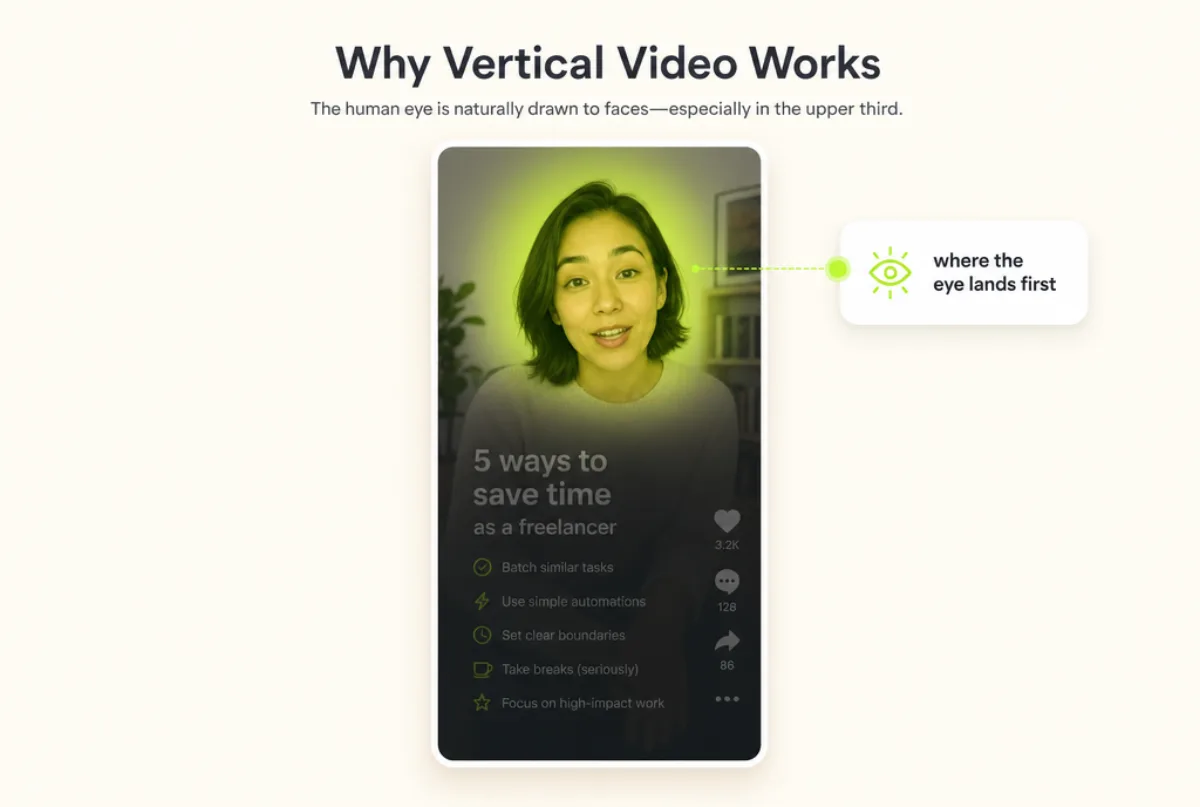 In the opening frames, the eye is pulled to motion, faces, and contrast before any word lands — a strong open puts something worth seeing exactly where attention goes.
🎯 The three things a strong open supplies
Opens that hold supply at least one of these instantly, before any words land:
| Signal | What it does | Quick example |
|---|---|---|
| Pattern break | Trips the triage reflex into "wait, what's this?" | Motion against a still frame, a face turning to camera, a hard cut |
| Open loop | A visible question with no visible answer — curiosity holds the thumb | "Watch what happens when…" with the result hidden |
| A stake | Signals "this matters to you" before the relevance arrives | Flash the result or the "after" up front |
You don't need all three — you need one, delivered before the thumb completes its motion.
Most strong opens lean hard on one and let the others arrive a beat later.
🔊 Why "say a punchy first line" is only half the advice
Most hook advice is about words: punchy first line, bold question, big promise. Not wrong — but incomplete, because words are slow.
A spoken sentence takes one to three seconds to land. The visual takes a few frames.
By the time your clever line finishes, the thumb-stop decision is usually already made — on what the viewer saw, not what you said.
| Hook layer | Time to land | What it can carry |
|---|---|---|
| Visual (motion, framing, contrast) | A few frames | Pattern break, stakes by implication |
| Audio onset (a beat, a sound, a voice) | A fraction of a second | A jolt, a tone, a vibe |
| On-screen text (3–6 words) | Under a second, if readable | A legible promise on mute |
| Spoken first line | One to three seconds | A claim, a question, the argument |
Layer them: let the frame and sound do the interrupting, let on-screen text carry the promise for muted viewers, and let the spoken line do the convincing.
Sound matters more than most creators think even in a muted feed — sound is half the video covers why an early audio onset measurably changes whether people stay.
❌ The most common ways a first second fails
If retention shows an early cliff, it's almost always one of these:
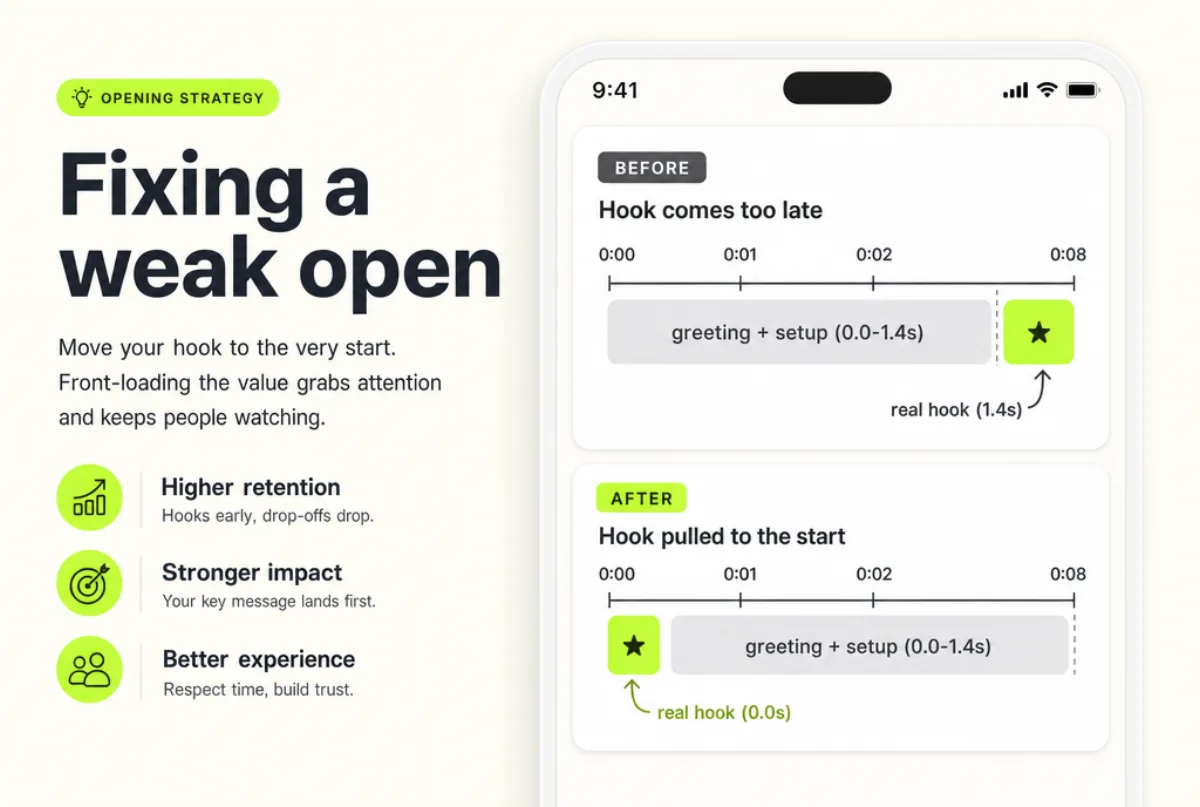
- The runway. The video starts three seconds before the interesting part — a logo sting, a slow zoom, a "let me set this up" preamble.
- The greeting. "Hey everyone, welcome back." Zero stake, zero pattern break.
- The inert frame. A static shot held while the audio gets going. The easiest scroll there is.
- The buried promise. The payoff is real but stated at second four. By then the people who'd care are gone.
- The clutter. Five things at once, none dominant. The eye can't find the point and gives up.
The fix is rarely "make a better video" — far more often it's "start one beat later, on the frame already doing the work."
We walk through that surgery in fixing a weak open — most of it is cutting, not creating.
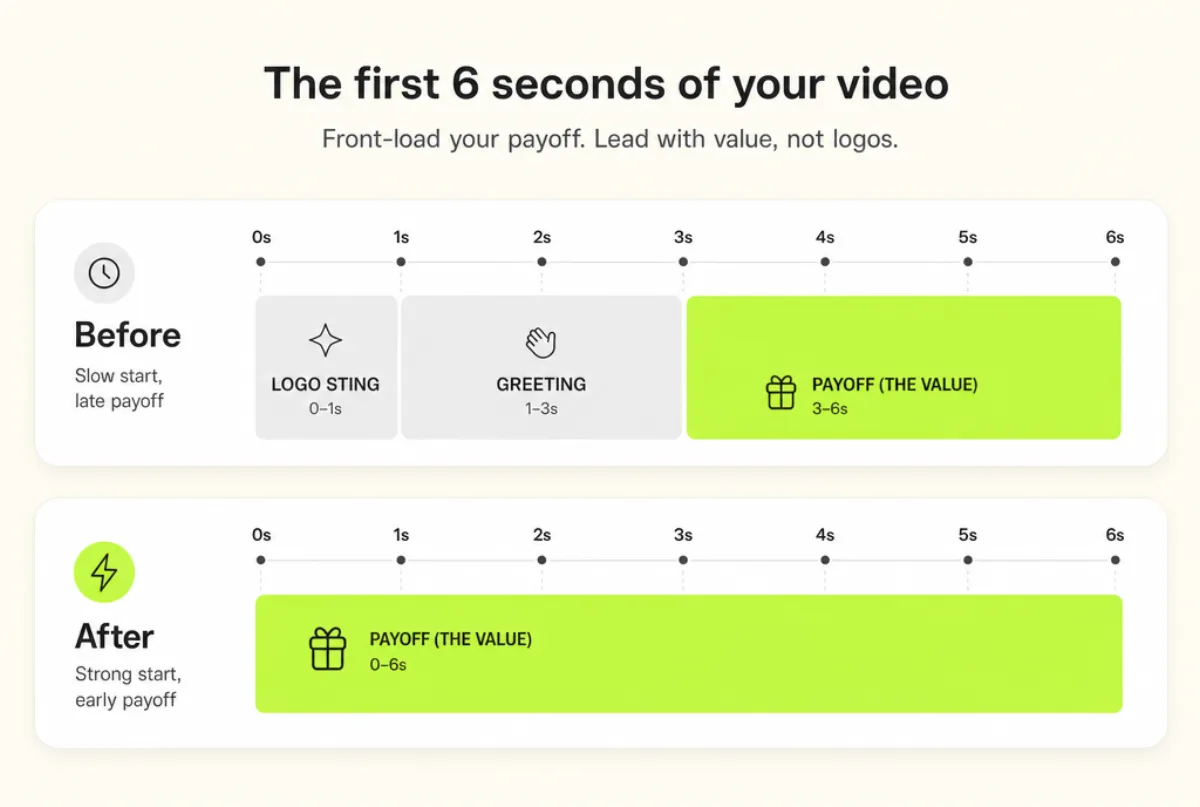 The most common hook fix isn't shooting something new — it's deleting the runway and starting on the frame that was already strong.
✅ Building for the negotiation, step by step
If the first second is an interrupt, designing an open is a concrete craft:
- Open on the most arresting frame, not the most logical one. The setup shot can wait. Lead with the pattern break, even out of order.
- Put motion in the first frames. Enter on a turn, a reveal, a gesture, a hand entering frame.
- Land an audio event early. A beat, a snap, a first word with energy — give the ear a reason to align with the eye.
- Show the stake, don't state it. Flash the result. Show the "after" first and rewind.
- Make it legible on mute. Three to six words of high-contrast text, placed where the eye already is.
A useful discipline: of every opening frame, ask "what is this frame doing to interrupt a departure?" If the honest answer is "nothing yet," it belongs later in the video.
This kind of pre-publish check fits into a repeatable routine — see test before you publish.
⚠️ Stopping the scroll is not the same as keeping it
A great first second can stop the scroll and still lose the viewer at second four.
The hook and the hold are different jobs with different physics — the hook interrupts a departure, the hold sustains a commitment being re-evaluated beat by beat.
Optimizing only for the open produces "clickbait curve" videos — a sharp spike, then a steep collapse as the promise goes unpaid — which trains the algorithm and the audience to distrust you.
The healthiest pattern is an honest interrupt with a follow-through that delivers on exactly what the open implied.
The full distinction is in hook vs. hold.
The way to read whether you won both jobs is the shape of your retention graph — how to read an attention curve shows what a healthy first second looks like versus a deceptive one.
✂️ Does the same first second work on every platform?
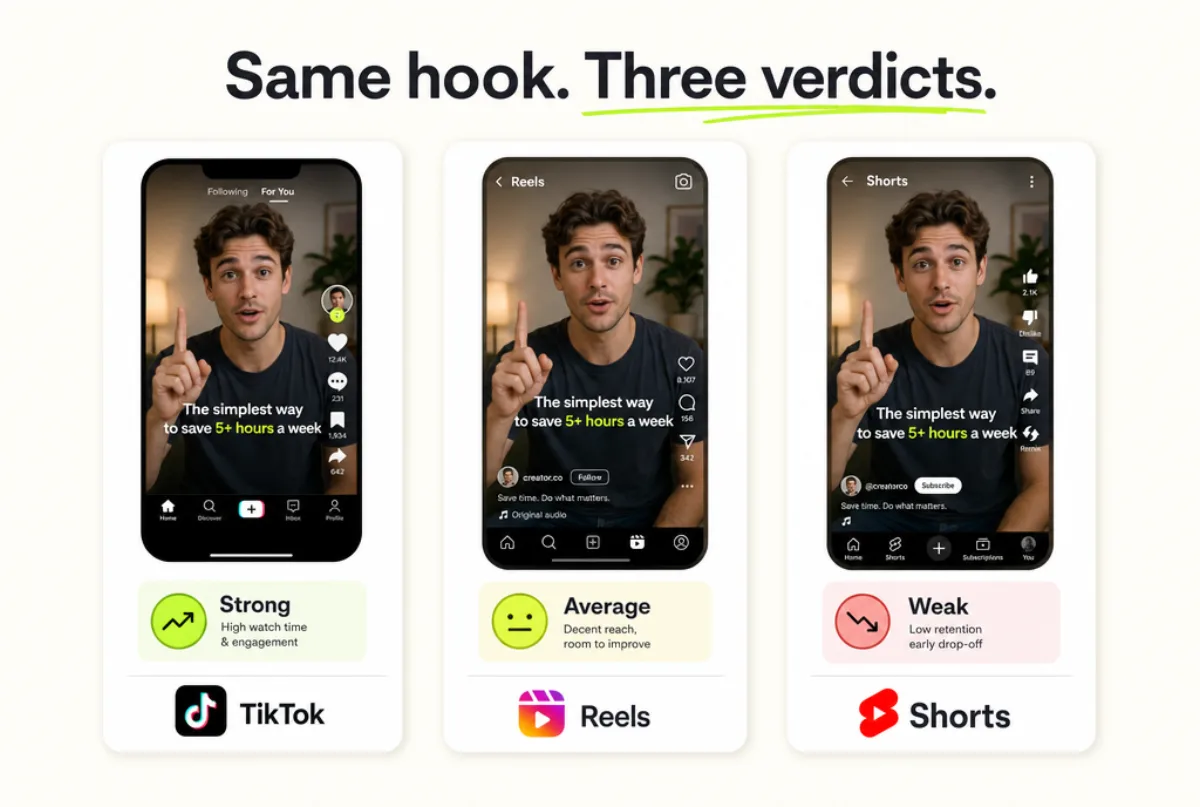
The instinct is universal — every feed points at the same reflex — but the texture of the scroll differs.
Autoplay behavior, default sound state, and what the neighboring clips look like all shape what counts as a pattern break.
The open has to feel different from whatever else is in that specific feed right now, and it has to survive being watched on mute.
The platform-by-platform nuance is in TikTok vs Reels vs Shorts.
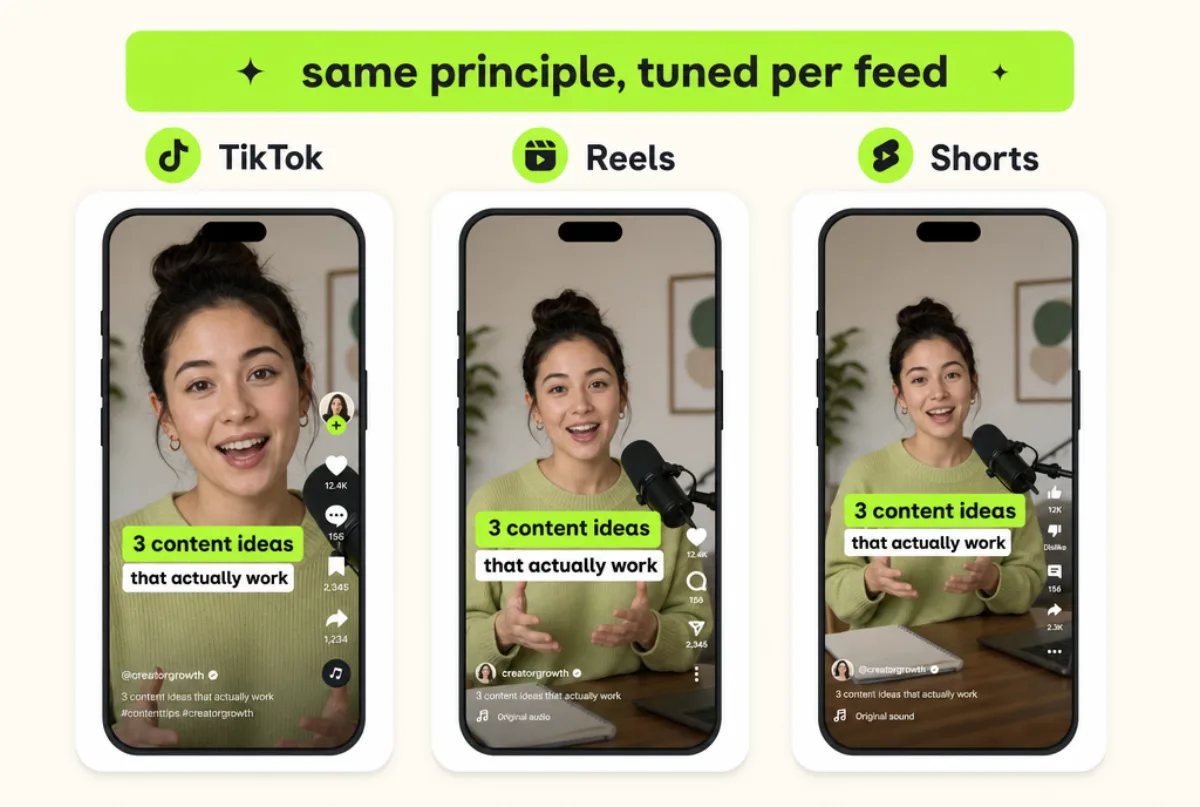 The reflex you're interrupting is the same everywhere; what reads as a pattern break depends on what the rest of that feed looks like.
📈 What this looks like as a hook score
A hook metric tries to read everything above.
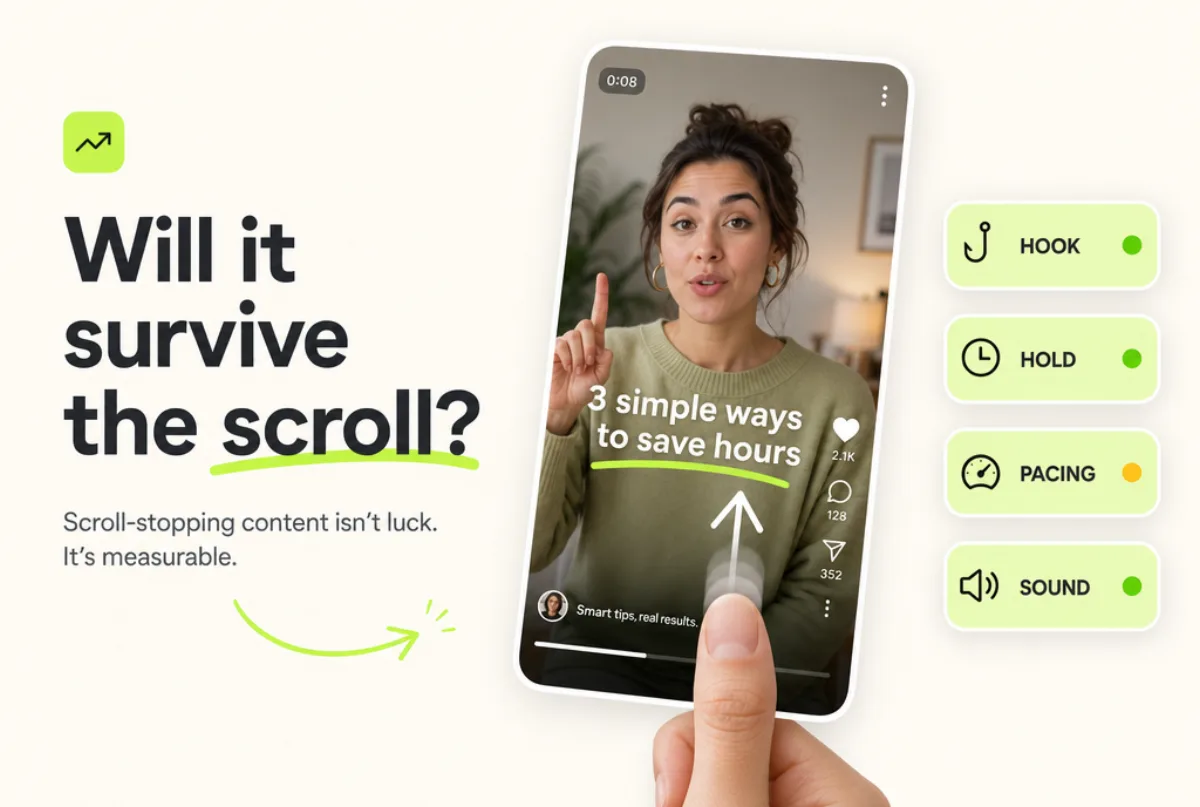
When Scrollproof reports Hook Strength, it analyzes the opening window for these signals: early saliency concentration, whether an audio onset lands, how much motion is present, whether a fast cut arrives, and whether there's a legible focal point a reflex could lock onto.
A high Hook Strength means the open is built to interrupt a departure — not that the video is good, and not a promise of views.
It predicts creative strength, not reach. For where that line sits, see what a virality score can and can't tell you.
A weak Hook Strength on an otherwise strong video is the most common, most fixable problem in short-form.
The first second is a negotiation whether you prepared for it or not — the only question is whether you showed up with an argument.
Frequently Asked Questions
Is it really the first second, or do I have three seconds?
Both, at different resolutions. The thumb-stop decision happens in roughly the first second, on what the viewer instantly sees and hears.
Most measurable drop-off accumulates across the first three seconds, as they confirm or reverse that snap call.
Do I need text on screen, or is a strong visual enough?
Use both. A striking visual stops the scroll; three to six words of high-contrast text tell muted viewers what they're being offered.
For the large share watching on sound-off, that text carries the promise audio would otherwise deliver.
Can a great hook save a weak video?
No, and trying backfires. A great open can stop the scroll, but if the body doesn't pay off, you get a sharp drop after the spike and train viewers to distrust your opens.
Hook and hold are separate jobs — see hook vs. hold.
How do I test whether my hook works before posting?
Two ways. After posting, the retention graph shows where viewers drop — a first-beat cliff is a hook problem.
Before posting, a pre-publish diagnostic reads the opening window for the signals viewers respond to instinctively. More on the live read in how to tell if a video will go viral before you post it.
What's the single fastest fix for a weak first second?
Cut the runway. Most weak opens have a strong frame hiding two or three seconds in, behind a logo sting, a greeting, or a slow setup.
Find the moment that already breaks the pattern and start there. Deletion, not creation — the highest-leverage edit in short-form.
More in fixing a weak open.
Want to see how your open scores before you post? Scan one free and get a read on your Hook Strength, hold rate, and attention curve in minutes.
Stop guessing. Scan the clip.
Drop a short video and get Hook Strength, Hold Rate, a second-by-second attention curve, and a real attention heatmap — in about a minute. First scans are free.