What a Virality Score Can — and Can’t — Tell You
A virality score is a useful instrument and a terrible oracle. Here's what it reads, what it can't, and how to use it honestly.
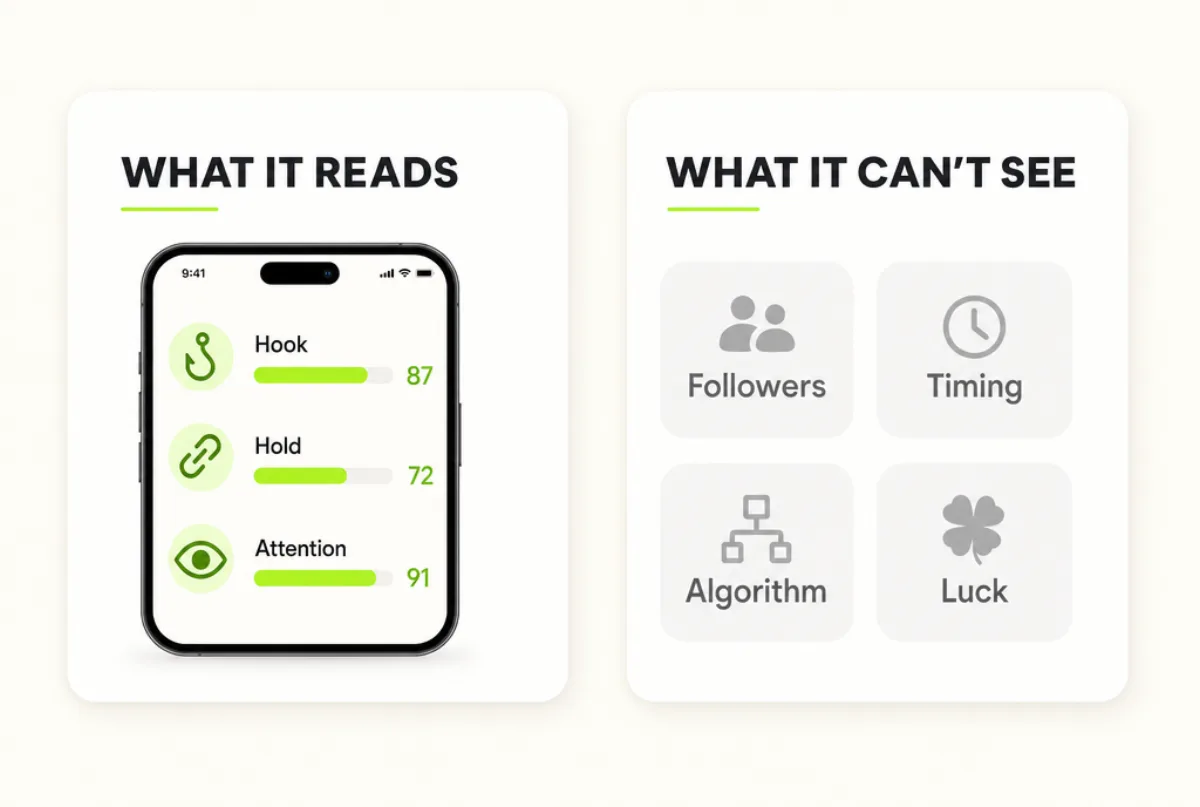
A virality score is a real instrument and a terrible oracle — both at once. The honest tools are clear about which half is which.
TL;DR — A pre-publish score reads how your clip is built to win attention. It can't see your account, your timing, the algorithm, or luck — so it can't promise views. Use it as a diagnostic, not a verdict.
🧠 What virality actually depends on
Whether a video takes off has five inputs. The creative is only one of them.
| Factor | Who controls it | Can a pre-publish score see it? |
|---|---|---|
| The creative — open, structure, pacing, sound | You | Yes |
| Your account — followers, history, standing | You, slowly | No |
| Timing — when you post, what's trending | Partly you | No |
| The algorithm — how the platform distributes | The platform | No |
| Luck — the right share at the right moment | Nobody | No |
A score computed before you post can only read the first row. Everything else happens after you publish — it doesn't exist yet for the tool to measure.
That isn't a flaw. It's the definition of a pre-publish score: it measures the one thing you can change with a recut tonight, and stays silent on the four you can't.
For the wider category, see what a virality predictor is and isn't.
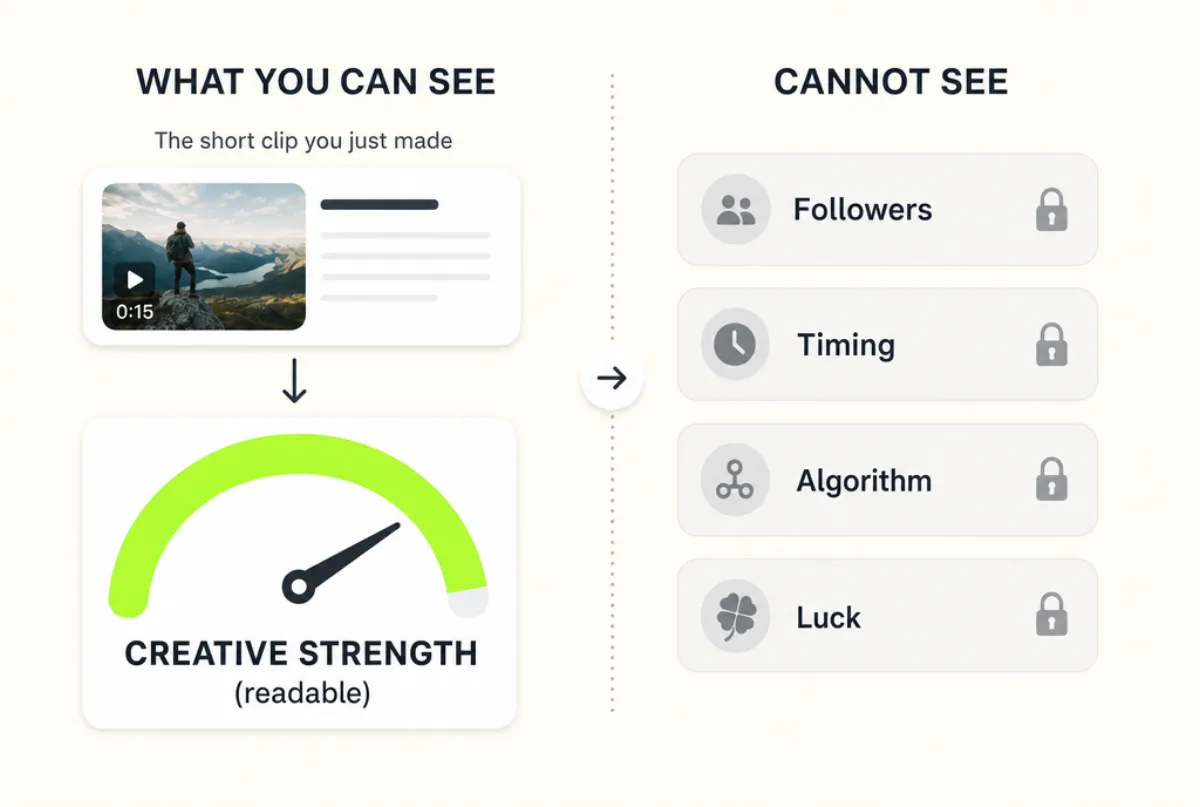 The creative is one of five inputs to virality. A pre-publish score reads exactly one — the one you can still change.
📈 What the score actually is
A virality score — the kind Scrollproof produces — is a predicted creative-strength signal. It's a transparent, weighted blend of measured channels:
- Visual saliency
- Motion
- Scene cuts
- Audio energy
- Face presence
Together these estimate how well a clip is built to stop the scroll and hold attention — how the video is built, not how it will perform.
A sharp open and a tight spine give you better odds. Odds are not outcomes.
A high score means: this is well-constructed to win attention. It does not mean: this will get X views, or this will go viral.
The headline number is the least useful part.
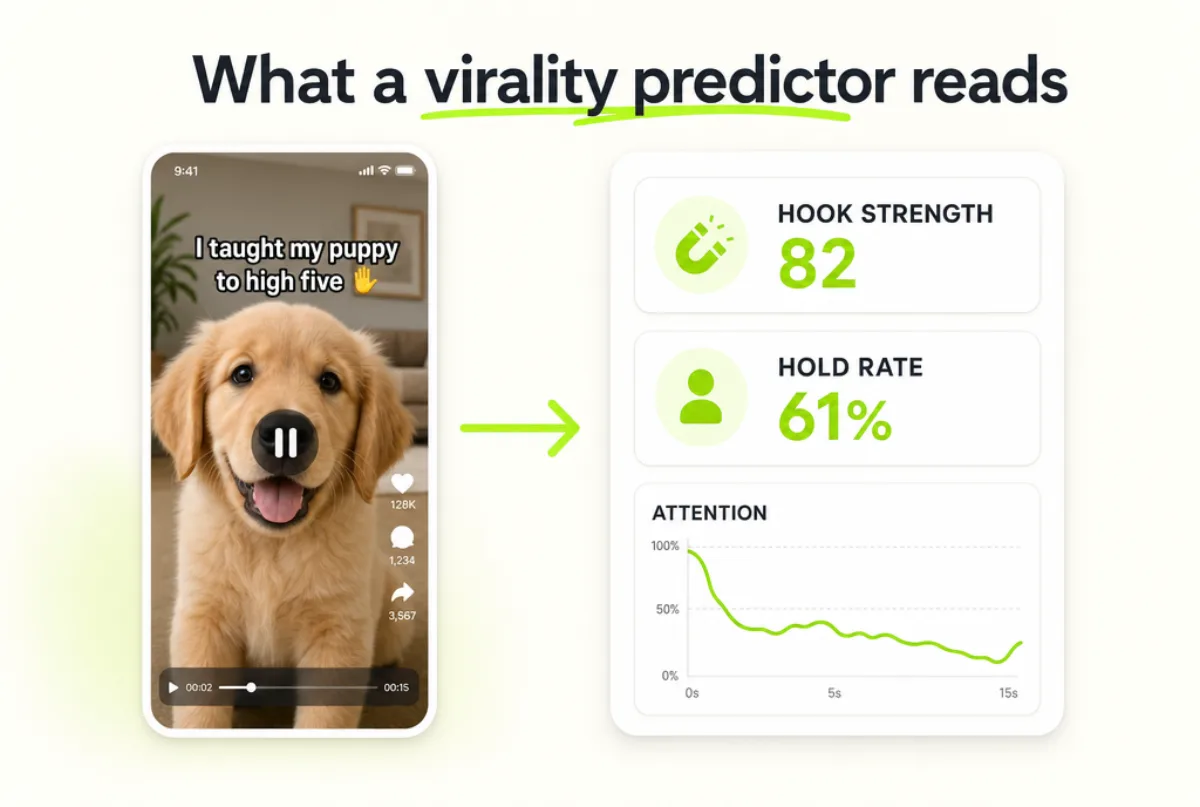
Underneath sit a hook reading and a hold reading, an attention curve, and a saliency map — that's the detail that tells you what to recut.
🔗 Why it's worth trusting at all
If the score can't see the algorithm, why bother?
Because every platform decides what to push using watch behavior — who stays past the first second, how far they get, whether they finish, replay, or share. The creative drives all of it:
- A weak open bleeds viewers in the first three seconds, before completion rate can even form — the make-or-break window is under 3 seconds.
- A saggy middle drops average-percentage-viewed.
- Confusing pacing kills replays and shares.
A creative-strength score is an upstream proxy for the downstream signals that move distribution. It measures what the algorithm reacts to.
The link is real but bounded: a strong read raises the ceiling; the platform still decides who sees it.
More in how to tell if a video will go viral before you post.
⚠️ Three caveats we print on purpose
We label these out loud instead of burying them in a disclaimer:
- The composite index is uncalibrated. It's an informed heuristic, not a validated probability. We have no published accuracy number, so we claim none. As creators share real outcomes, we'll publish the honest figure — weak spots included — when it's real.
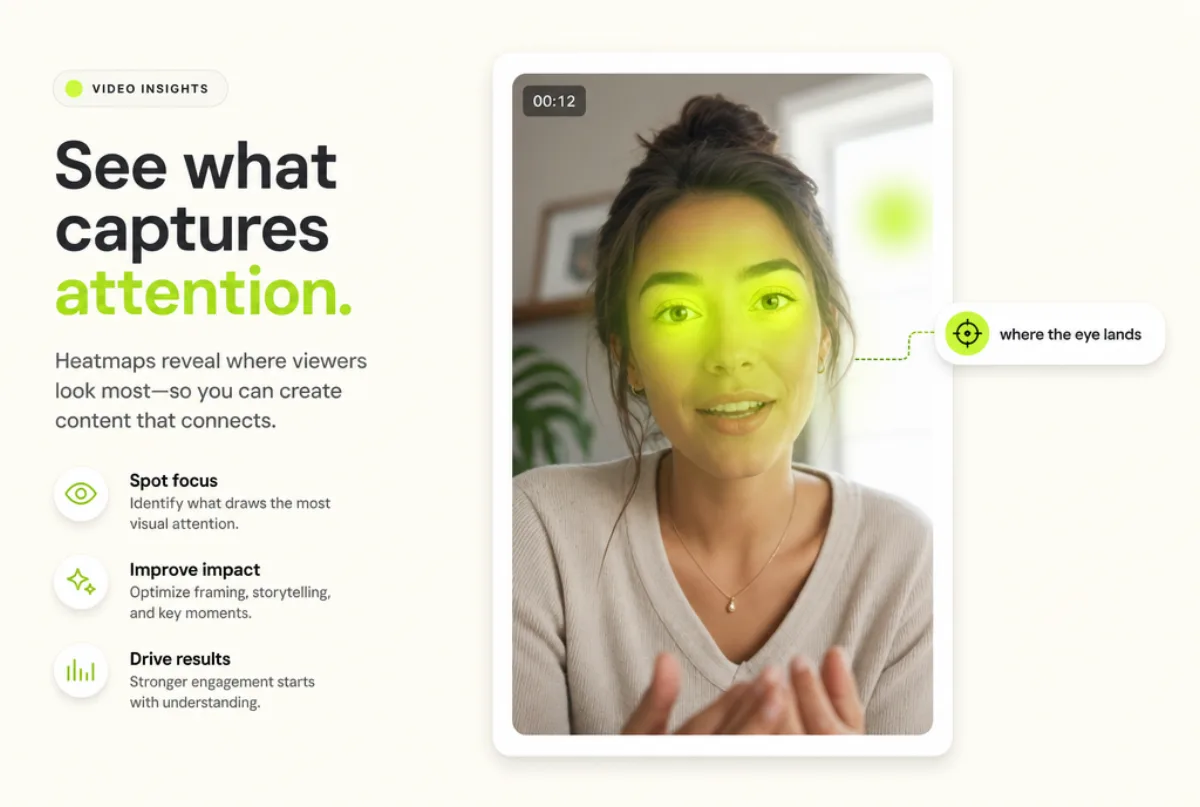
- The heatmap is illustrative, not medical. It's a visual-saliency model of where the eye is likely pulled — see how visual saliency works. It is not an fMRI or EEG. "Brain-style" is a metaphor, not a measurement.
- We don't promise views, reach, or revenue. There's no honest path from a pre-publish read to a guaranteed audience outcome, so we don't pave one.
Any tool that hides these is selling the gap between what it can measure and what you want to hear.
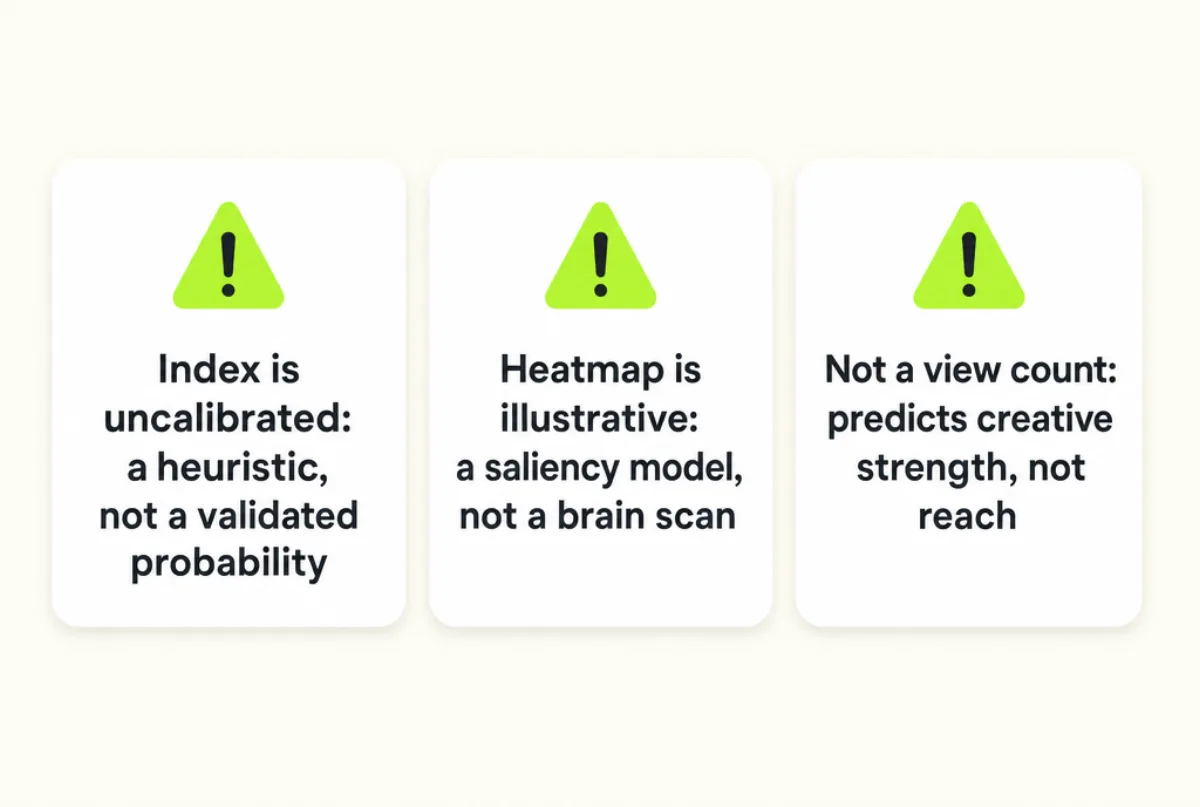 Three caveats we print on purpose. A tool that hides these is the one to distrust.
✅ High score vs. low score
People over-read both directions. Here's the calibrated read:
| Result | What it tells you | What it doesn't |
|---|---|---|
| High score | The craft works — the open interrupts, the structure holds, the eye lands right | That the idea is interesting, the audience cares, or the trend is alive |
| Low score | One beat is leaking attention — a buried hook, a slow first frame, a dead second six | That the whole video is bad |
The low score is the more useful one — it points at a location, not a verdict.
Find that beat and recut it. Don't scrap the clip.
💡 How to use a virality score well
The score is more useful precisely because it's bounded.
A number that claimed to predict your views would be unfalsifiable — when it missed, you'd never know if the creative, the timing, or the algorithm was at fault.
A score that only reads the creative gives you something you can act on tonight:
- As a diagnostic, not a verdict. Low score? Ask "which beat is it reacting to?" — then recut that beat. The attention curve usually shows you exactly where focus drops.
- As a comparator, not an oracle. Its most reliable use is relative: this cut reads stronger than that one. A clean A/B between your own versions cancels out the model's uncertainty.
- As one input, not the decision. It catches unforced errors — a hook that opens on a logo, a payoff that lands too late. It doesn't judge whether the idea was worth making.
- Inside a repeatable loop. Fold it into a pre-publish testing workflow: scan, recut the weakest second, rescan.
A bounded instrument makes claims small enough to be true and specific enough to be useful.
🎯 What it can't replace
Name the things a score will never give you, so you don't wait for them:
- Whether your idea deserves to exist.
- Whether a trend peaked last Tuesday.
- Whether your audience is tired of this format.
- Whether a competitor just did the same bit better.
It reads the craft of one clip in isolation — it has no view of the culture the clip is dropping into.
It also won't tell you which platform rewards which open. The same first second can read strong on one feed and flat on another — that's a strategy call, covered in does the same hook work on TikTok, Reels, and Shorts.
The score sharpens the instrument; you still aim it.
🤝 Honest by design is the whole point
A virality score tells you whether your clip is built to win the part of the game that's in your hands.
A tool honest about that is the only kind worth trusting — and the only kind that helps.
Trust comes from a published methodology, scores that trace to real signals, plain statements of where the model is weak, and a clip deleted shortly after analysis.
The confident black box that promises views is comforting right up until your clip flops and the number gave you nothing to fix.
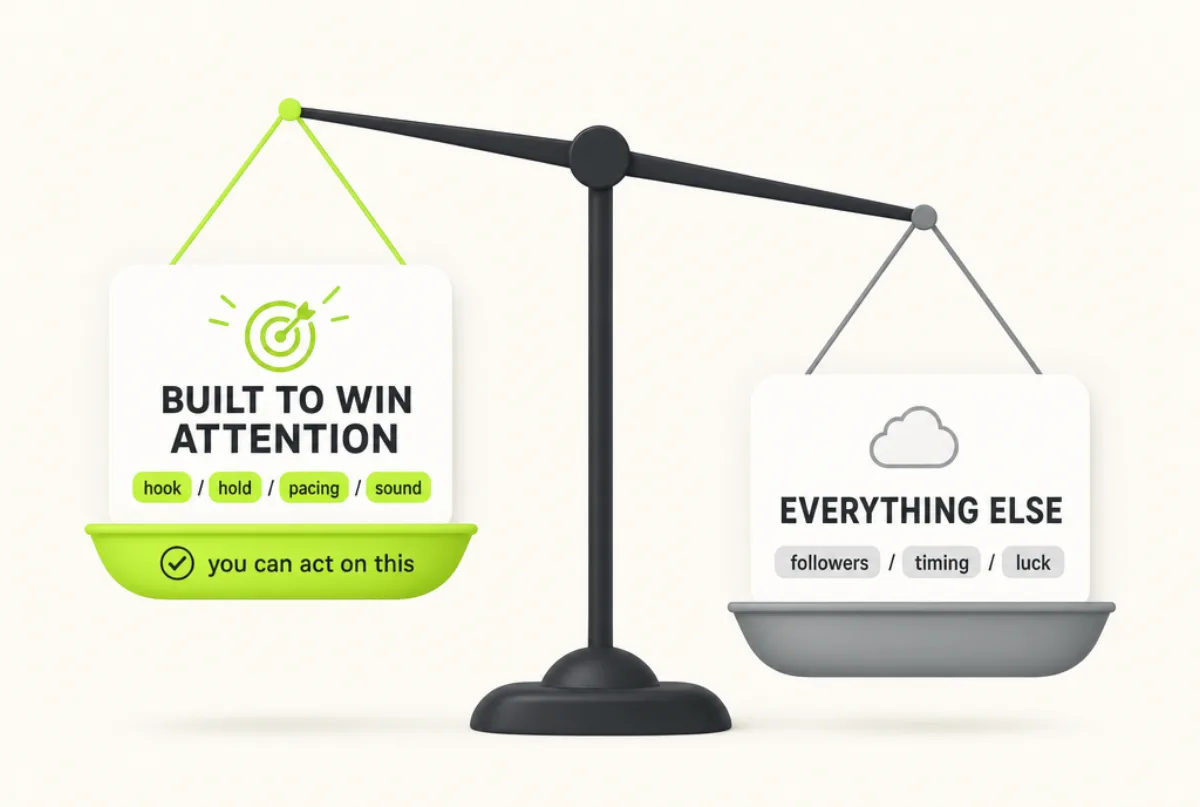 The honest trade: a small, true claim you can act on beats a big, comforting claim you can't.
Frequently Asked Questions
Does a high virality score mean my video will go viral?
No. A high score means the clip is well-built to stop the scroll and hold attention — the part of virality in your control.
It can't account for your followers, timing, the algorithm, the topic's moment, or luck. It raises your odds; it can't promise an outcome.
Why doesn't Scrollproof publish an accuracy percentage?
Because we don't have a validated one yet, and we won't borrow a fake number to look credible. The index is currently an informed heuristic.
As creators share real outcomes, we're building the dataset to calibrate it — and we'll publish the honest figure, weak spots included, when it's real.
Should I trust the score or my own judgment?
Both, in that order. Use the score to catch unforced craft errors — a buried hook, a dead middle, a late payoff.
Use your judgment for what it can't see: whether the idea is worth making, whether the audience cares, whether the trend is alive.
What's the most reliable way to use the number?
Use it as a comparator, not an absolute. Scan two cuts of the same clip and trust the relative read — "this version holds better."
Relative comparisons cancel out the model's uncertainty, which is why a pre-publish testing loop beats staring at one score.
Is the attention heatmap reading my brain?
No. It's a visual-saliency model that estimates where the eye is likely pulled, computed from contrast, motion, faces, and composition.
It is not an fMRI, an EEG, or any neurological measurement. "Brain-style" is a metaphor for the visual pattern, not a claim about your brain.
Want to see what an honest creative read looks like on your own footage? Scan one free — the number won't promise you views. It'll show you the one second worth recutting.
Stop guessing. Scan the clip.
Drop a short video and get Hook Strength, Hold Rate, a second-by-second attention curve, and a real attention heatmap — in about a minute. First scans are free.