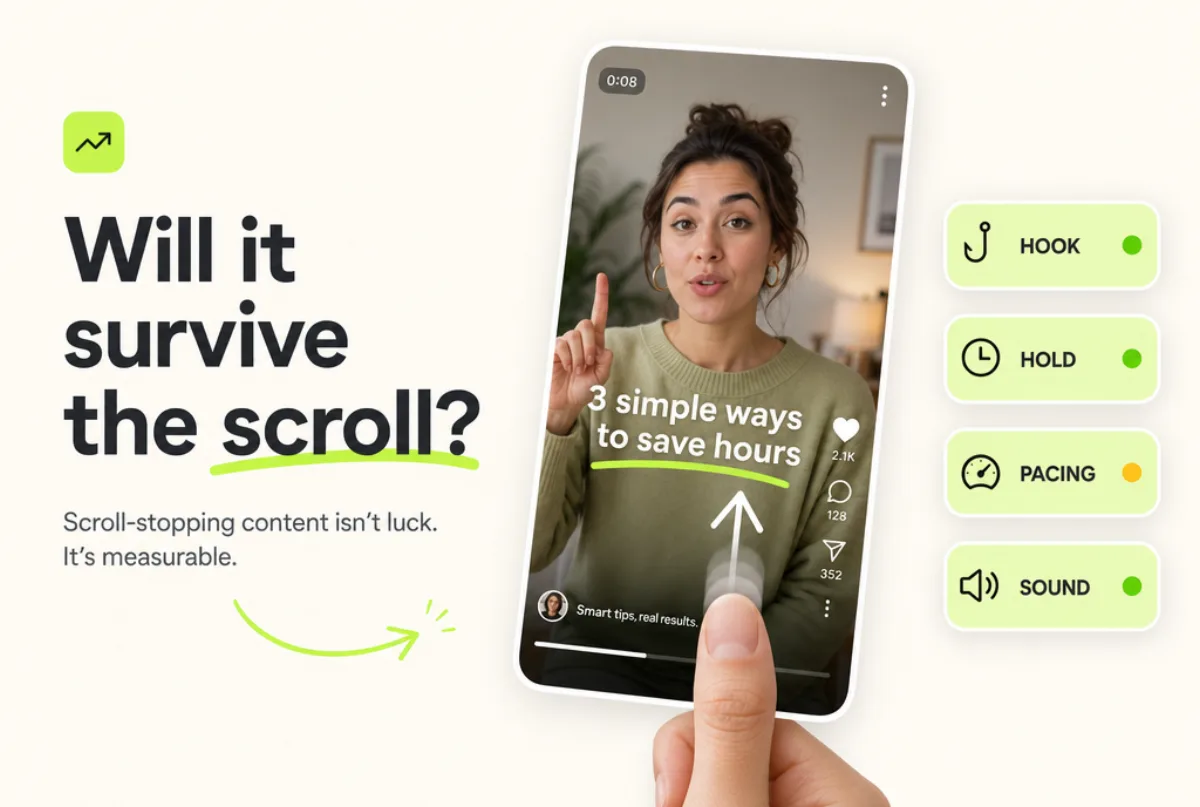
Test Before You Publish: A Workflow, Not a Gut Check
A repeatable pre-publish loop for short-form: read the cut cold, find the weak beat, change one thing, ship — before it's irreversible.
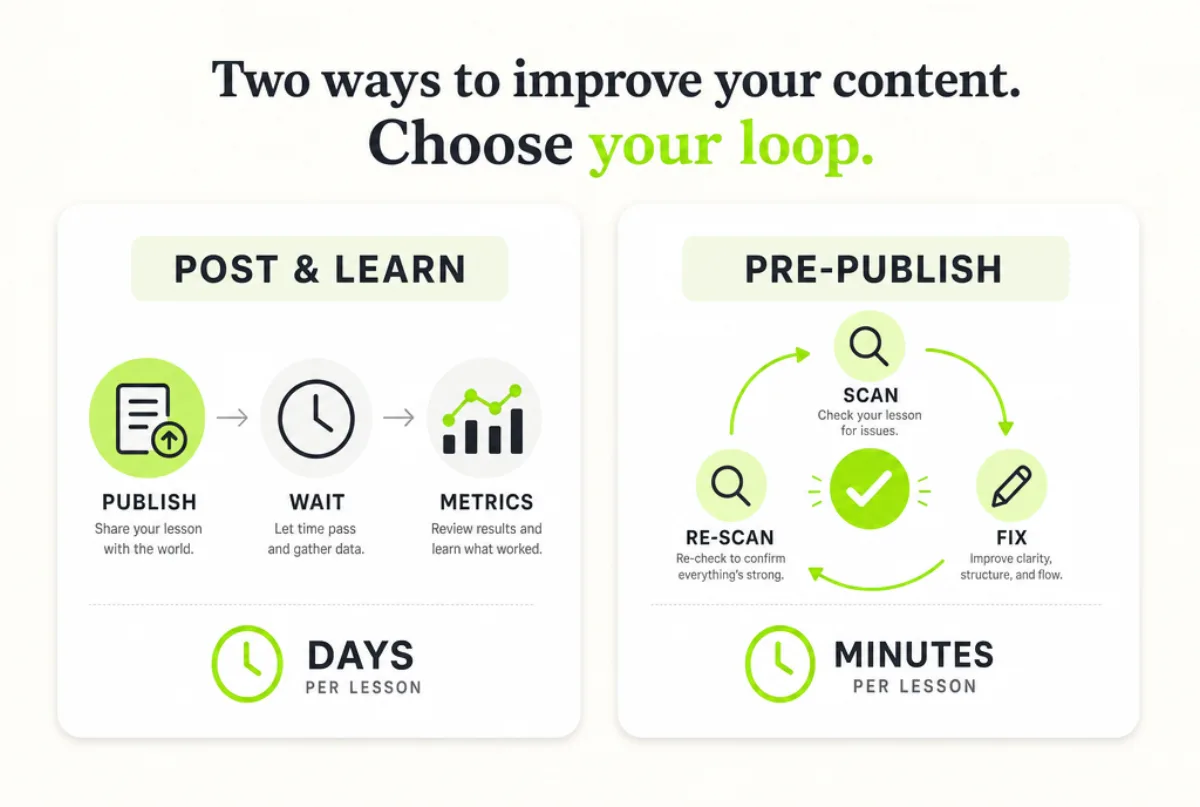
Most short-form gets one real piece of feedback — metrics — and they arrive after the video is live, when you can't change a thing.
TL;DR — Move the feedback earlier. Read the cut before you post, find the single weakest beat, change one thing, re-read, ship. It doesn't make you right — it makes you informed before it's irreversible.
💸 Why "post and learn" is an expensive teacher
Published performance has three problems stacked on each other:
- Slow. One lesson per post — a few data points a week, if you're prolific.
- Confounded. It mixes creative, algorithm, timing, account standing, and luck. You can't tell whether the open was weak or the feed just didn't favor you — same reason a virality score can't tell you everything.
- Punishing. Your worst experiments run on your real audience. A flat open spends real reach to teach you a lesson.
Pre-publish testing fixes all three: the loop runs in minutes, the creative is isolated because there's no distribution yet, and a bad cut costs a recut, not a post.
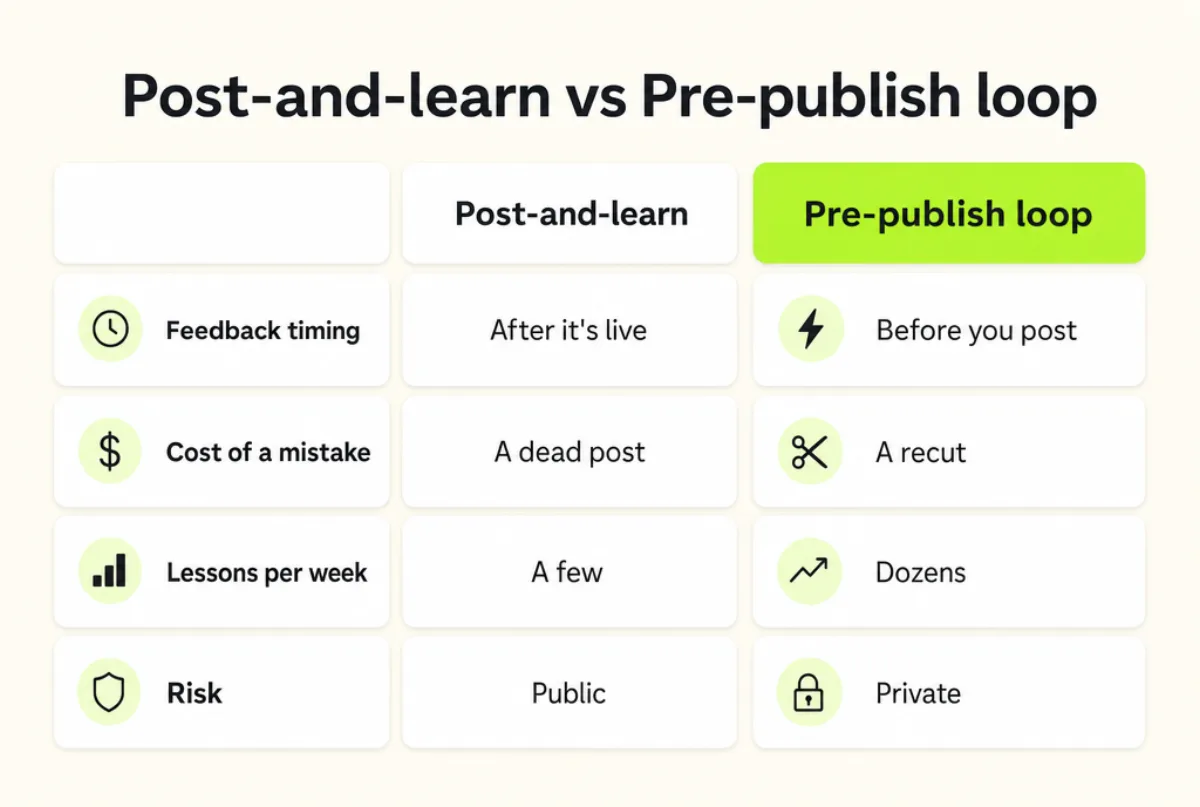 The pre-publish loop changes when feedback arrives, how fast it arrives, and what it costs to be wrong.
| Post-and-learn | Pre-publish loop | |
|---|---|---|
| Feedback timing | After it's live | Before you post |
| Loop speed | Days per lesson | Minutes per iteration |
| What's measured | Creative + algorithm + luck | The creative, isolated |
| Cost of a bad version | Real reach, real audience | A recut |
You don't stop watching published metrics — those are still ground truth. You stop using publishing as your only test.
The live feed is a great judge, a terrible lab.
📈 The loop, step by step
Small and repeatable on purpose — cheap enough to run every time, not a special occasion.
- Cut a version. What you'd actually post — same open, length, sound. A placeholder teaches you about a video you'll never publish.
- Read it cold. Get an outside read before your own familiarity blinds you.
- Find the weakest beat. Not "is it good" — where is it weakest? The open? A dead middle? A payoff that doesn't pay?
- Change one thing. Re-cut that single beat, so you can tell what the change did.
- Re-read. Did the weak beat improve? Did anything else get worse?
- Ship when it stops improving cheaply. Not perfect — "no obvious cheap win left."
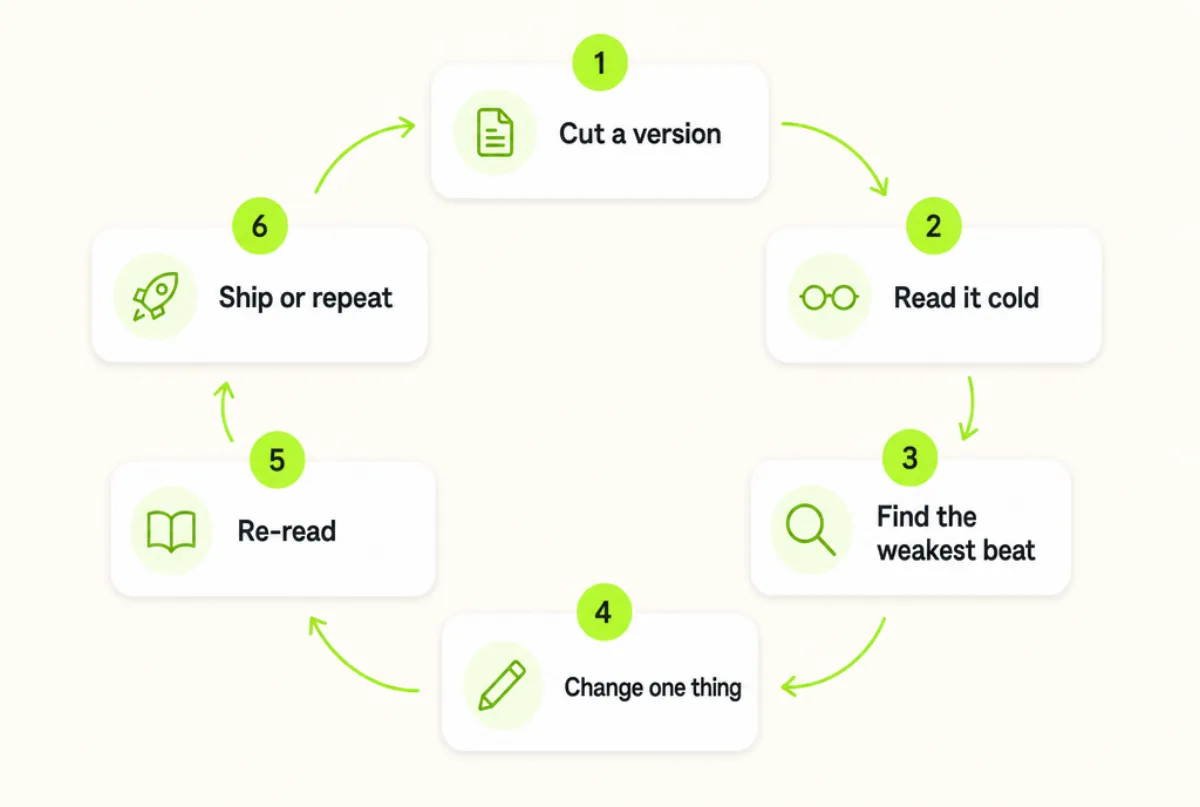 The loop is small on purpose — cheap enough to run on every cut, not just the important ones.
The order matters: read before you analyze, analyze before you edit, edit one thing before you re-read. The common failure is collapsing steps 3 and 4 — editing before you've located the weak point, so you polish beats that were already fine.
👁️ Reading the cut cold
Step 2 is the one humans are worst at. By the time a clip is cut, you've lost what your audience has: ignorance of what happens next.
You can't un-know the payoff, so you can't feel the open the way a cold viewer does.
Three ways to fake a colder read:
- Time-separate. Look again the next morning. Costs a day.
- Borrow eyes. Show someone new — but watch them, not the screen. The moment their attention drifts is your real data, usually earlier than they'll admit.
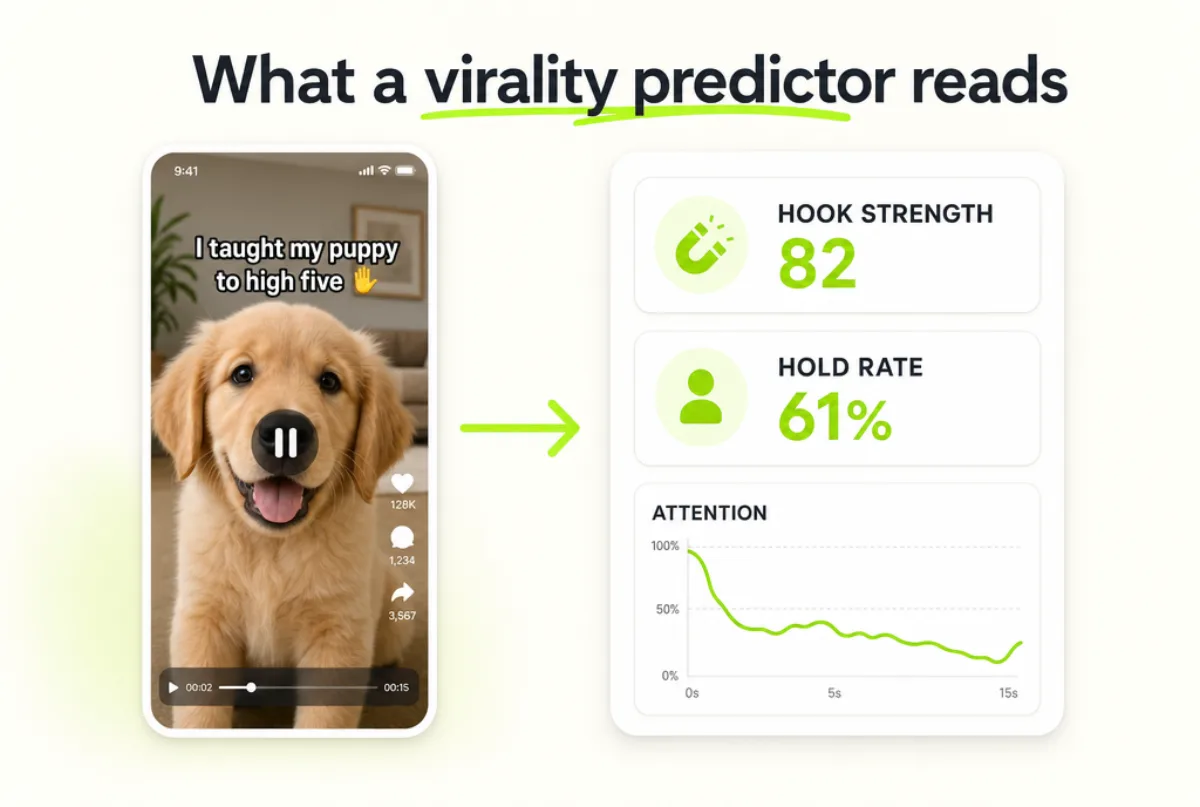
- Measure it. A computer-vision read doesn't get bored, doesn't get polite, and doesn't know the payoff is coming — the blind, first-impression read you can no longer give yourself.
Fastest version: a measured read for the objective signal, plus your own taste for the fix. The diagnostic finds the leak; you design the fix.
🧠 The discipline that makes it work: change one thing
The habit that separates testing from busywork is isolating the variable.
Change the open, music, and pacing at once and the read improves — but you can't tell which change helped, so you can't repeat it.
Change one beat. Re-read. Attribute the difference to that beat. "This kind of open reads stronger" is a lesson that compounds. "This video got better somehow" dies with the video.
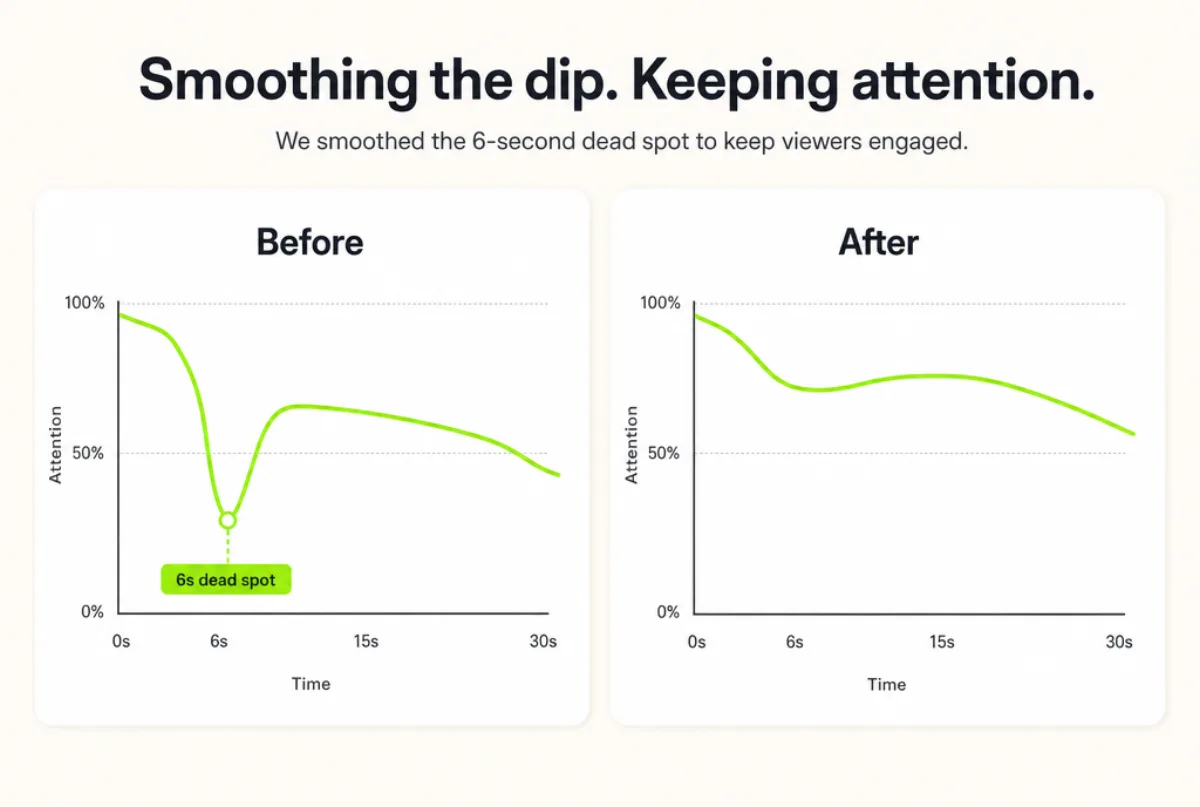 Change one beat, re-read, attribute the difference. A clean comparison is the only kind you can learn from.
Slower per video, far faster per creator. After 30 clean comparisons you know how your openers behave — that accumulated intuition is the real return, bigger than any single video it improved.
🎯 What to test first: open, spine, sound
Attention follows a priority order. Test in the same order — fix what gates everything downstream first.
| Test | What it controls | Where it earns its keep |
|---|---|---|
| 🎯 Open (always first) | Whether the video gets watched at all | A weak open caps every other improvement |
| ⏱️ Spine (second) | Whether attention holds after the hook | Slow leaks: flat middles, tangents, long beats |
| 🔊 Sound (third, underrated) | Energy and momentum | The variable people forget to test |
- Open. The first second decides whether the video gets watched. No point polishing a payoff most viewers never reach. If the read flags it, here's the playbook for fixing a weak open.
- Spine. Once the open holds, the job shifts from stopping the scroll to keeping it — the difference between hook and hold. Slow leaks show up as a sag when reading the attention curve. Often the fix is rhythmic — pacing and cuts hold attention as much as content does.
- Sound. Audio carries more retention weight than most creators credit — a muddy first line, a flat music bed, a gap of dead silence.
Test in this order and your iterations land where they have the most leverage.
⚡ Fitting the loop into a real cadence
I post daily, I can't run six steps on every clip. Fair. So shrink it.
- Fast days — two-step minimum: read the cut; if the open is weak, fix only the open. 30 seconds, catches the most expensive error.
- Hero pieces, launches, paid spend — full loop: the economics flip. A recut is cheap; a wasted ad budget on a weak open is not.
- Weekly rhythm — batch it: cut several clips, read them in one sitting, rank by weak beat, edit the most fixable first.
You're triaging, not perfecting. The loop scales down to fit the calendar — it doesn't slow your output.
⚠️ What pre-publish testing is not
Over-claiming is how this category lost trust. The limits:
- Not a guarantee. A strong read improves your odds; it doesn't promise an outcome. Distribution, timing, and your account still decide a lot — none of it visible before you post.
- Not a replacement for taste. The tool tells you where attention is likely to break. What to do about it is your call.
- Not a reason to homogenize. It catches unforced errors — the dead open, the buried payoff — so your voice gets a fair hearing. It doesn't sand videos down to whatever reads highest.
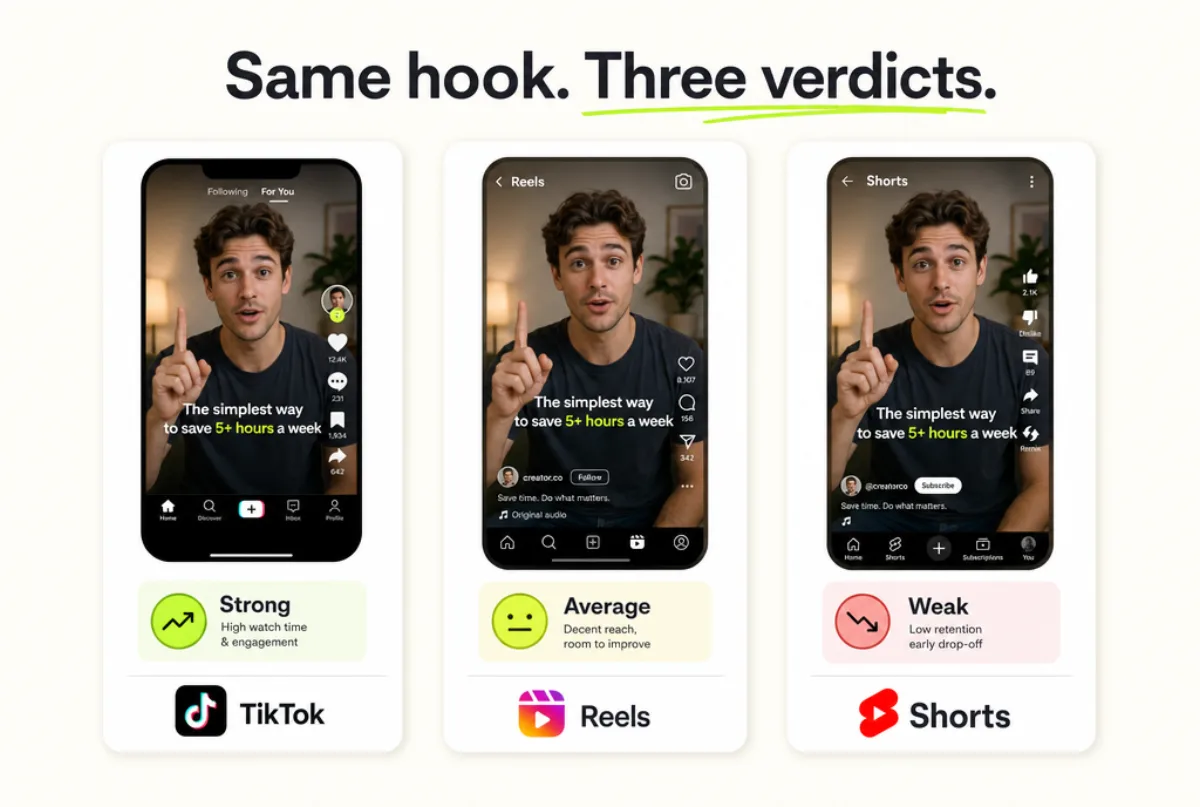
- Not platform-blind. The same cut can read differently across surfaces, since the same hook doesn't always work on TikTok, Reels, and Shorts.
✅ Where Scrollproof fits
This loop is why Scrollproof exists: a read on a clip before you publish, fast enough to run on every cut.
- Hook Strength → the open.
- Hold Rate + attention curve → the spine.
- Visual-attention heatmap → where the eye actually lands in each frame.
The point is never the score — it's the next recut it points you toward.
The creators who improve fastest aren't the ones with the best instincts on day one. They're the ones who turned the loop over the most, before it counted.
Frequently Asked Questions
What is pre-publish testing for short-form video?
It's getting feedback on a video before you post it, while you can still recut — instead of relying only on metrics that arrive too late to act on.
The goal is catching unforced errors like a weak open or a flat payoff, when fixing them costs a recut, not lost reach.
How long does the testing loop actually take?
The full six-step loop runs in minutes per iteration. On a tight schedule, shrink it to two steps: read the cut, fix the open if it's weak.
Reserve the full multi-pass version for launches and hero pieces where being wrong is expensive.
Why does "change one thing" matter so much?
Changing several things at once tells you the video improved but not why. A single-variable change lets you attribute the difference to that edit — turning one clip into a transferable lesson.
That's how testing compounds into intuition.
Doesn't testing make every video look the same?
It shouldn't, used right. The loop targets unforced errors, not your creative choices.
It exists so your voice gets a fair hearing — not to sand videos down to whatever reads highest. The fix is always your call.
Can a pre-publish read guarantee my video goes viral?
No, and any tool that says so is overselling. A strong read improves your odds by removing creative weak points.
But distribution, timing, and account standing still decide a lot — and none of that is visible before you post.
Want to run the loop on your next cut? Scan one free and read the open before you post it.
Stop guessing. Scan the clip.
Drop a short video and get Hook Strength, Hold Rate, a second-by-second attention curve, and a real attention heatmap — in about a minute. First scans are free.