Fixing a Weak Open: A Field Repair Guide
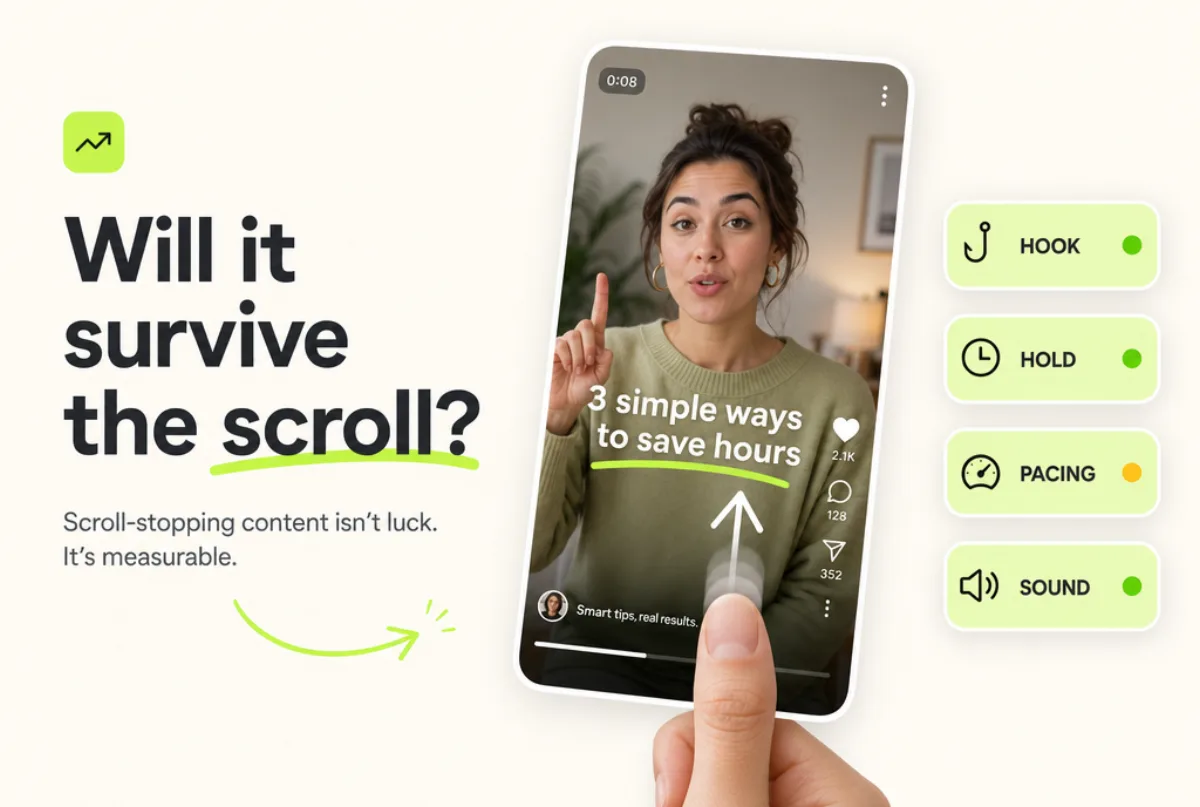
Your open reads weak. Here's the ranked repair playbook — the fixes that move a hook most, and the one that fixes more weak opens than the rest.
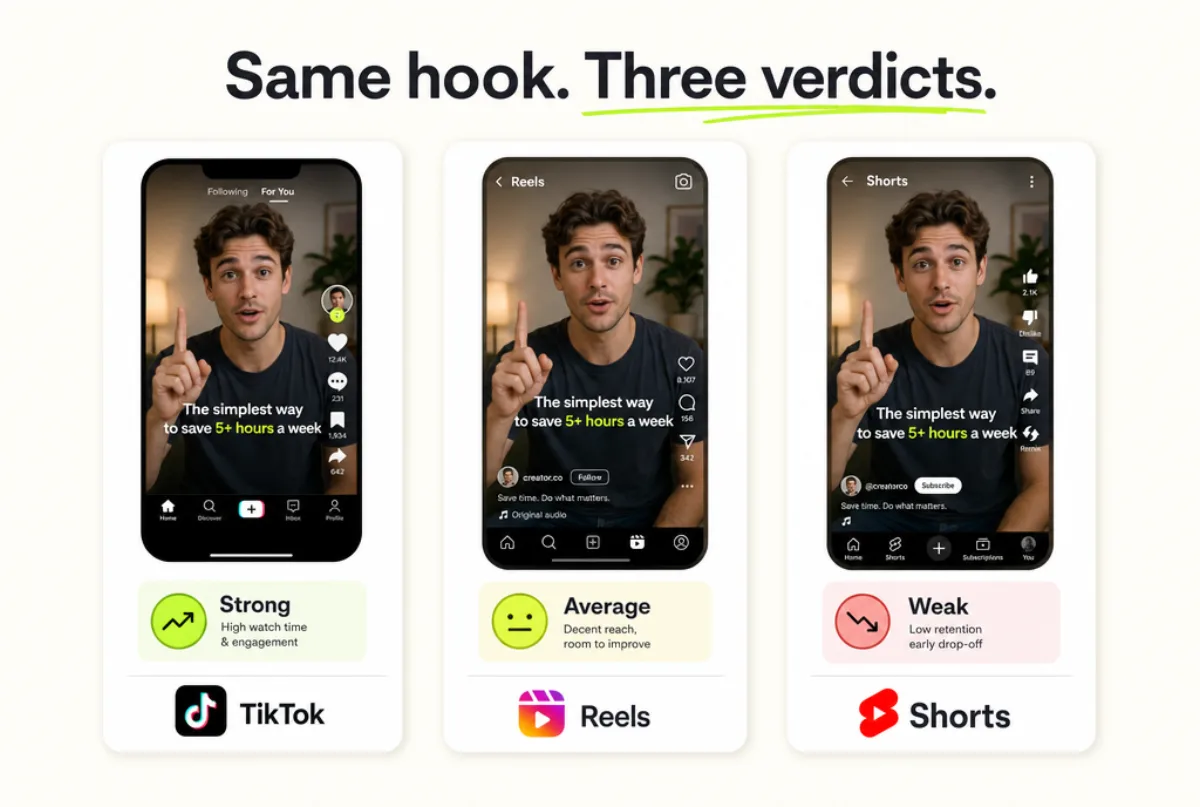
A read tells you the open is weak. Now what?
This is the repair half — ranked, practical, ordered by how much each move shifts a hook.
TL;DR — Most weak opens aren't missing a hook. They're hiding one behind runway. Cut to the arresting moment first, then work down the ladder — one change at a time.
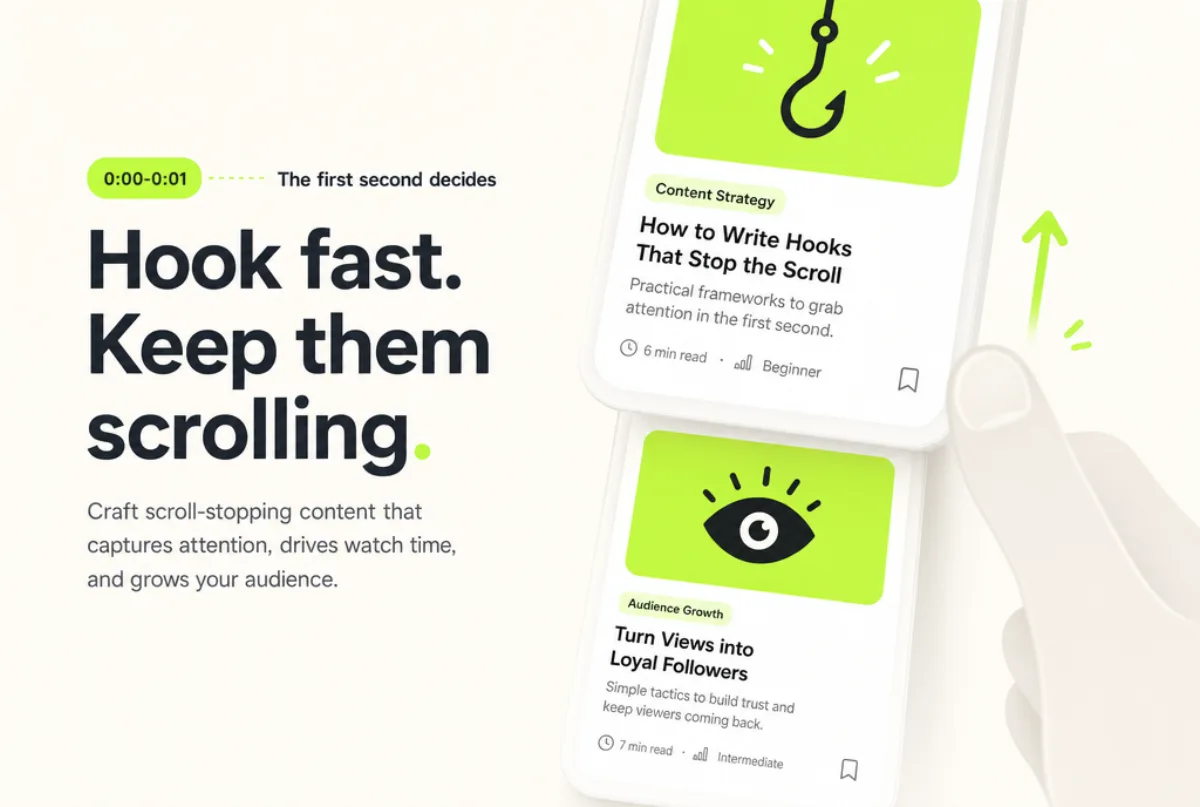
Theory first? The first second is the survival decision, and most videos die before three seconds. This guide assumes that's settled.
🧠 Diagnose before you operate
Don't reach for a fix until you know which kind of weak you have.
Almost every flat open is one of two problems — and the repair is completely different for each.
- Buried hook. The arresting moment exists. It's sitting behind a runway of setup. The footage is fine; the order is wrong.
- Missing pull. No involuntary trigger in the opening frames at all — no motion, no audio onset, no contrast steering the eye.
Watch your first second with the sound off and ask: would anything make a stranger stop?
- "Yes, but it's three seconds in" → buried hook (fix with a cut, costs nothing).
- "No, nothing — even at three seconds it's slow" → missing pull (needs a new element, sometimes a reshoot).
Diagnose first. The fastest fix is free, but only if you've named the problem correctly.
✂️ The one move: cut the runway
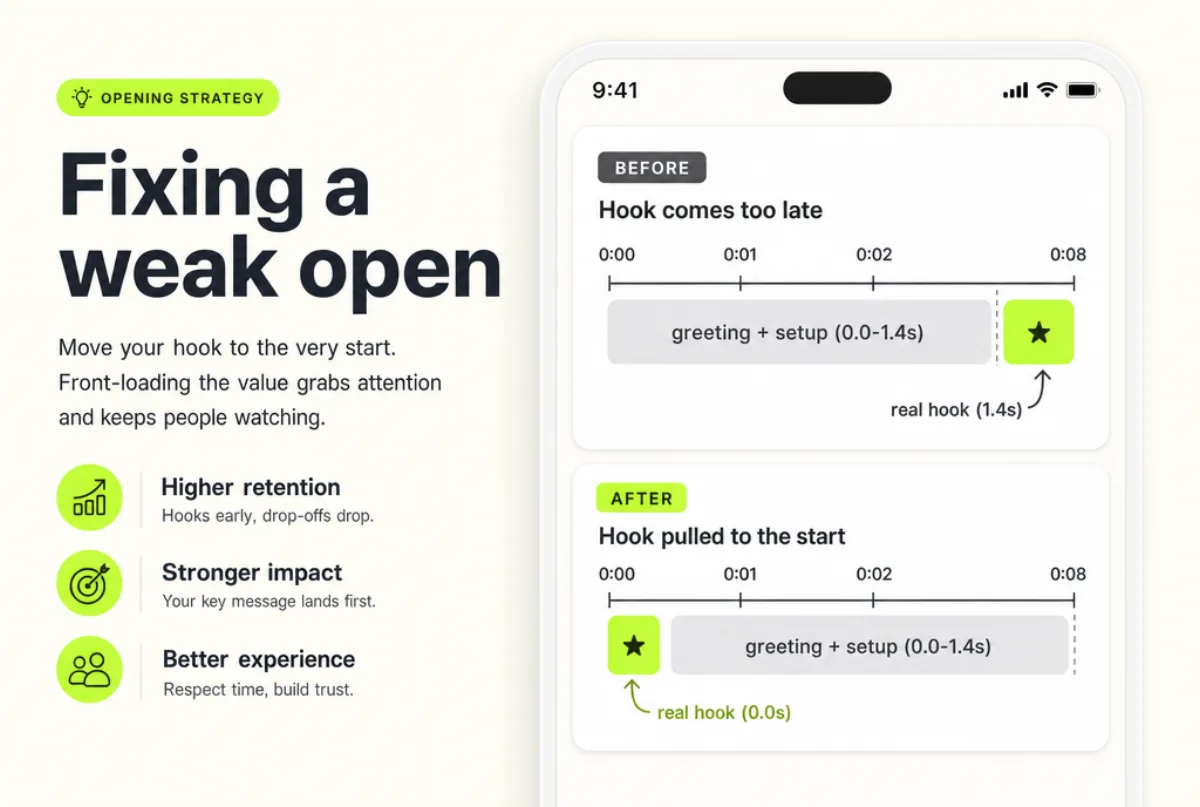
Most weak opens are weak because the good part is buried behind throat-clearing — a greeting, a slow establishing shot, a "so today I wanted to talk about," a breath of dead air.
The fix: find the first genuinely arresting moment and start there. Delete everything before it.
Why it works: the thumb-stop decision happens in the first second. Whatever is in your first second is your hook — designed or not.
A runway hook doesn't stop thumbs.
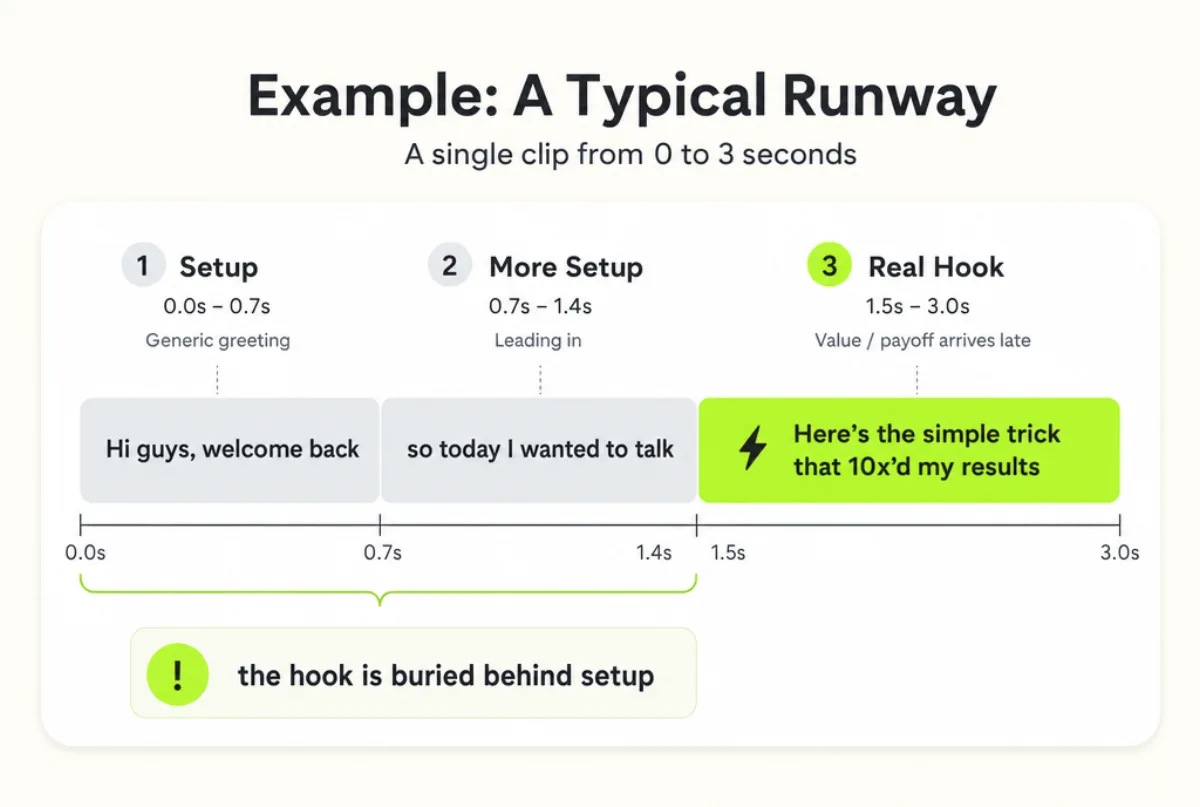 The runway problem: the good part is there — it just arrives after the viewer has already decided.
Even when you think your open is fine: delete your first sentence and first shot, then watch it back. If it's sharper, they were runway. They almost always are.
This is the highest-leverage move because it's the only one that makes the video shorter.
You're not adding a hook — you're removing the thing hiding it.
📋 The repair ladder, ranked by impact
When cutting the runway isn't enough — or there's no obvious moment to cut to — work down this ladder.
Order is rough; the right move depends on your diagnosis.
| # | Fix | Best when... | Why it works |
|---|---|---|---|
| 1 | Cut the runway | A strong beat hides behind setup | Your real hook becomes frame one |
| 2 | Open on motion | Your first frame is static | Motion is the strongest involuntary pull |
| 3 | Lead with the result | The payoff is something you can see | Curiosity loves a consequence it can see |
| 4 | Add an audio onset | Visually fine but silent | A second hook arrives through the ear |
| 5 | Land a fast first cut | One frame holds a beat too long | A cut resets attention at the decision |
| 6 | Reframe for contrast | The subject sits in a dead zone | Pop-out steers the eye to the right place |
| 7 | State the stake | The "why care" arrives too late | Relevance, signalled before it's explained |
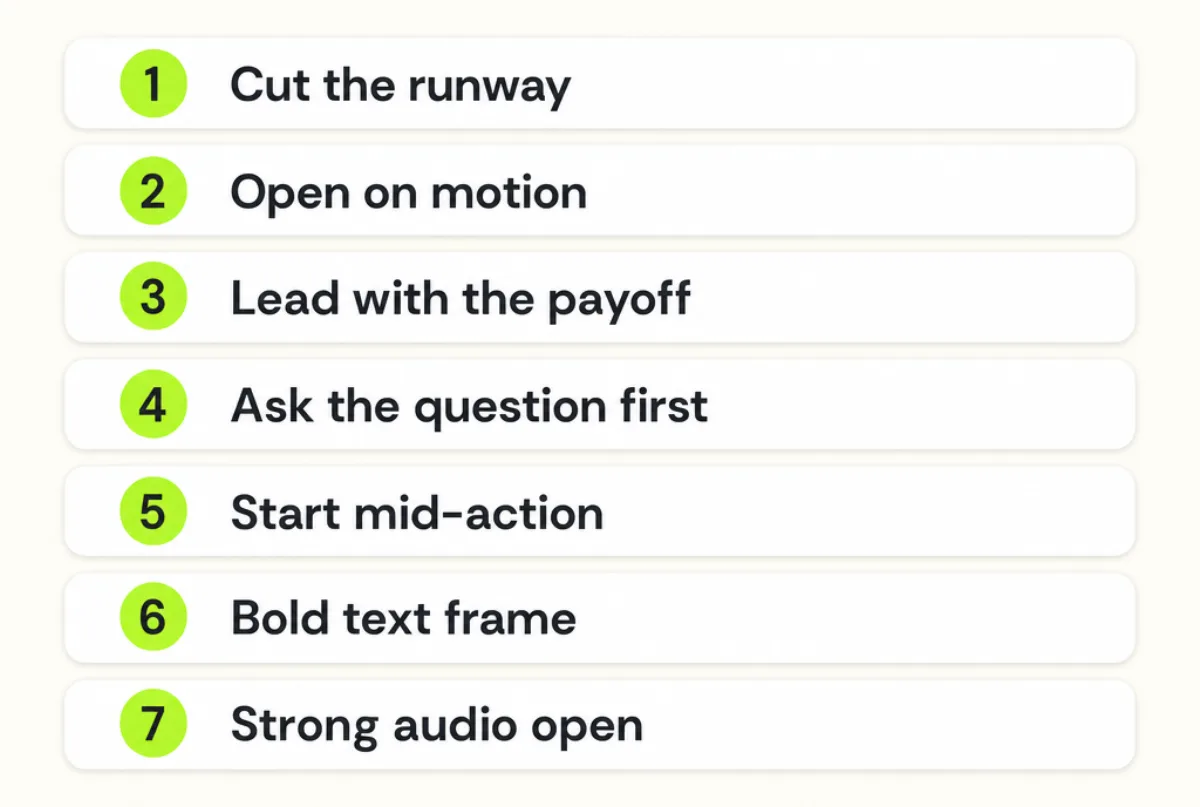 The repair ladder. Work down it, but lead with the fix that matches your diagnosis.
👁️ Open on motion when the frame is static
A static open forfeits the strongest pull there is. Movement yanks the eye before conscious attention catches up — it's the heart of how visual saliency works.
Re-cut so the open lands on change: a turn, a gesture, a reveal, a hand entering frame, a subject already mid-motion.
- You don't need a whip-pan. Even slow, deliberate movement beats a held still.
- A frozen frame reads like a thumbnail the viewer has already seen.
- No motion in the footage? A subtle push-in or scale animation manufactures change. Weaker than the real thing, better than nothing.
The principle is change. A changing frame reads as alive; a frozen one reads as already-seen.
💡 Lead with the result to open a loop
If your video builds to a visible payoff — a finished dish, a transformation, a reaction, a number on screen — flash that result first, then rewind to how you got there.
This opens a loop the rest of the video closes. The viewer now has a consequence to be curious about, and curiosity is a held breath.
The discipline: show, don't narrate. "Wait for the end" is a promise viewers discount.
A two-frame flash of the real result is one they can see — and believe. That's the line between hook and hold.
🔊 Add an audio onset when the open is silent
A visually decent open that's silent for its first half-second leaves a hook on the table. The ear is a second channel running in parallel — two hooks pulling together beat one.
Drop a deliberate audio event into the opening frames:
- A transient or beat.
- A first word delivered with energy.
- A sound effect that lands on the visual.
The point isn't volume — it's onset. A sound that begins sharply registers as an event; one that fades in doesn't.
Sound also holds, not just hooks — that's the subject of audio and retention. For the open, just don't open on dead air.
⏱️ Land a fast first cut to reset attention
If the open holds one frame a beat too long, energy sags right where you need it highest.
A cut early in the first beat stacks a visual event onto the open exactly when the thumb-stop decision is being made.
A cut is a reset — each new shot re-engages the eye and buys a second decision point. This is pacing and cuts applied to the open.
More cuts is not better. A cut works because it's a change against a baseline — cut constantly and there's no baseline left. One sharp early cut beats five.
👁️ Reframe for contrast when the subject hides
Sometimes the open isn't slow or silent — the subject just sits in a low-contrast spot while a brighter element steals the eye.
The gaze lands on the wrong thing, decides there's nothing here, and scrolls.
This fix doesn't change what happens — it changes where the eye lands:
- Simplify the background.
- Kill the competing highlight.
- Move the subject into a cleaner contrast pocket, the brightest and most isolated thing in frame.
This is the same pop-out mechanic from how visual saliency works, applied as a repair.
A heatmap earns its keep here: if heat pools on a background light instead of the face, you've found the cause without guessing.
⚠️ State the stake when "why care" comes late
If a viewer can't tell fast why this matters to them, they leave even when the craft is flawless. Signal the stake early — ideally shown, not said.
It sits lowest because it's hardest to add in the edit. A genuine stake usually wants to be designed in — written into the first line, framed into the first shot.
Add it later when you can (a text overlay naming the payoff); when you can't, it's the note that improves your next video most.
📈 Re-read after exactly one change
The discipline that makes the whole ladder work is the same one behind all pre-publish testing: change one thing, then re-read.
- Cut the runway and re-read. Improved? You found it — stop.
- Didn't move? Undo and try the next fix down.
- One change at a time tells you which repair your weakness responded to — and that's the transferable knowledge.
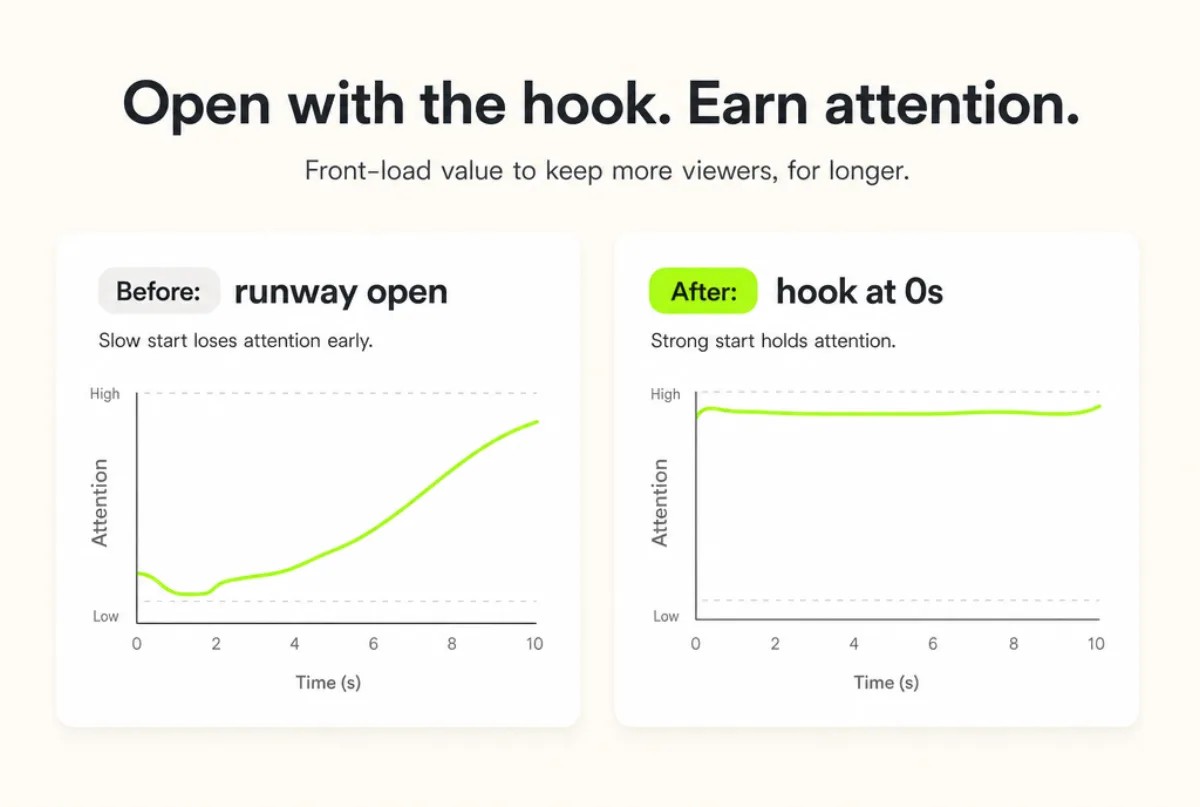 Re-read after one change. A fixed open shows up as a peak at frame one, not a valley.
Stack three fixes and you've maybe fixed this open but learned nothing.
It's the loop a pre-publish testing workflow is built around, and why reading the attention curve after each change beats reading it once.
✅ A worked example, repaired
A how-to clip opens with "Hey everyone, in today's video I'm going to show you how I fixed this." The first arresting moment — the visible repair — is at 2.6 seconds.
- Diagnosis: buried hook. Good part behind 2.6 seconds of runway.
- Move 1 — cut the runway. Delete everything before the repair; open on the broken thing mid-fix. Re-read: flat → sharp. Often the whole fix.
- Still soft? Move 2 — open on motion. Recut so the first frame is the hands already working.
- Still soft? Move 4 — audio onset. A single sound effect on the first frame of contact.
The ladder isn't a checklist to run top to bottom — it's the next move, ready when the obvious one falls short.
And keep perspective: a strong open predicts creative strength, not guaranteed views — a score reads the craft, not the algorithm.
Frequently Asked Questions
What is the single most effective fix for a weak open?
Cutting the runway — deleting the greeting and slow setup so your first arresting moment becomes frame one.
Most weak opens hide a hook rather than miss one. It costs nothing and makes the open denser by shortening it.
How do I know if my open is weak before I post?
Watch your first second with the sound off and ask if anything would make a stranger stop.
"Yes, but three seconds in" means a buried hook; "no, nothing" means a missing pull. A pre-publish read on hook strength and the attention curve formalizes that gut check.
How many fixes should I apply at once?
One. Change a single thing, then re-read. If the read improves, stop; if not, undo and try the next move down.
Stacking fixes might repair this open but teaches you nothing transferable.
My open isn't slow or silent but still reads weak — why?
Likely a missing or misdirected involuntary pull. The subject may sit in a low-contrast dead zone, or the frame may be static with no motion.
Reframe for contrast, or recut to open on movement.
Can I fix a weak open in the edit, or do I need to reshoot?
Most are fixable in the edit: cutting the runway, opening on motion, adding an audio onset, an early cut, reframing for contrast.
The one that often needs a reshoot is stating the stake — making "why care" clear fast usually wants to be designed into the first line and shot.
Want to know which kind of weak open you have before you publish? Scan one free with Scrollproof and get a read on hook strength, attention curve, and visual-attention heatmap — so you fix the actual cause instead of guessing.
Stop guessing. Scan the clip.
Drop a short video and get Hook Strength, Hold Rate, a second-by-second attention curve, and a real attention heatmap — in about a minute. First scans are free.